Showing posts with label Museum. Show all posts

Aug 17, 2010

NATIONAL JAZZ MUSEUM of HARLEM Acquires a Treasure Trove of Jazz Recordings


For decades jazz cognoscenti have talked reverently of “the Savory Collection.” Recorded from radio broadcasts in the late 1930s by an audio engineer named William Savory, it was known to include extended live performances by some of the most honored names in jazz — but only a handful of people had ever heard even the smallest fraction of that music, adding to its mystique.
After 70 years that wait has now ended. This year the National Jazz Museum in Harlem acquired the entire set of nearly 1,000 discs, made at the height of the swing era, and has begun digitizing recordings of inspired performances by Louis Armstrong, Benny Goodman, Billie Holiday, Count Basie, Coleman Hawkins, Lester Young, Bunny Berigan, Harry James and others that had been thought to be lost forever. Some of these remarkable long-form performances simply could not fit on the standard discs of the time, forcing Mr. Savory to find alternatives. The Savory Collection also contains examples of underappreciated musicians playing at peak creative levels not heard anywhere else, putting them in a new light for music fans and scholars. - ( Larry Rohter - The New York Times )

http://www.nytimes.com/2010/08/17/arts/music/17jazz.html?hpw

-FUPPETS- dreams of running into a hidden musical treasure such as this. Amazing stuff. What can be played is being cleaned up and digitized by the Museum, and hopefully they can share that music with the world, and not get bogged down in copyright and royalty issues.

Jul 23, 2010

-FUPPETS- Corpse Flower Update: The Stink Is Here

Checking in with the Houston Museum of Natural Science's blog -FUPPETS- has gotten word that the infamous Amorphophallus titania, or "Corpse Flower", has begun it's wretched stink. It has taken a couple of weeks to get here but it has been well worth it.
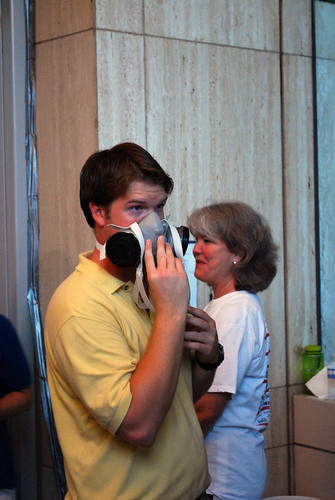
The stench is so wretched that the HMNS staff that attend to the flower have started wearing gas masks. No lie!


Well, Houston – the stank is upon us.

We got the call at 4:30 this morning, with the news that those of you who were queing up to see her overnight already knew – Lois is a stinky, stinky plant.

Seriously. She smells. Bad.

So bad that staff and media in the gallery with Lois are availing themselves of gas masks to cope. And we’re not even to peak stink yet. Lois’ spadix (the tall center spike) is heating up – and that heat is what helps the stench to spread. As of 7 am, the spadix was 90 degrees, while the surrounding environment was a mere 81. Zac [the museum's resident horticulturist] has also measured Lois height a final time – and she stands at 69.75 inches tall. - ( Erin F. - HMNS )


The Beginning of the Bloom [Corpse Flower] 7.21.10 from HMNS on Vimeo.


There have been only 28 other blooms of this flower in the U.S. since it was discovered and brought over here by horticulturists in the 19th century. It is a very rare sight and smell indeed.

Jul 14, 2010

Houston Corpse Flower Brings the Funk

-FUPPETS- made the trip yesterday to witness the putrid olfactory melange wafting from the Corpse Flower at the Houston Museum of Natural Science. (Click the images below to enlarge)


Even though the flower had not yet truly opened, the noxious smell of rotten flesh was still in the air. People from all over were there to see this monstrosity. It seems that either humans are curious about any morbid subject, or there are a lot of horticulturists and botany fans out there! The lines were long but not overly so. Due to the nature of this temporary exhibit, there were no signs or museum docents there to speak about the flower, so anyone who did not do their research (or read -FUPPETS-) beforehand was not going to learn too much about the largest flower on Earth. It was still an awesome sight, having grown 60 inches in less than two weeks.


Like Halley's Comet, or any other wonder of nature, it pays to be informed about what one is going to be looking at. It seems that too many people go through life unimpressed by the amazing shit in life because they expect an amazing experience, instead of just expecting a glimpse at something which is in itself an amazing thing. Oh well. -FUPPETS- was there.

In tribute to the Corpse Flower, -FUPPETS- presents the one and only UNWOUND, performing Corpse Pose.

UNWOUND - Corpse Pose

Jul 13, 2010

Houston CORPSE FLOWER Update

The Houston Museum of Natural Science has decided to stay open 24 hours a day until the infamous "corpse flower", Amorphophalus titanium, finishes it's once-in-a-lifetime blooming.

There is a webcam here that feeds live images of this incredible specimen.

-FUPPETS- will be paying a visit to the Museum today to catch a first-hand glimpse and whiff of this most remarkable flower. Full details will be forthcoming. This flower's bloom is very unpredictable, but it has grown to a height of over 60 inches, and is starting to show color on the edges of it's "petals." The intense reek of death it emanates is strongest for the first 2 hours after it blooms, but it remains stinking for up to ten additional hours.
Explorers in Sumatra thought, because of it's amazing size and pungent stench, that it was a huge man-eating plant!

Jul 8, 2010

CORPSE FLOWER To Bloom In Houston Soon

-FUPPETS- has been interested in the Titan Arum, or Amorphophallus Titanum, since first reading about this strange flower years and years ago. It is one of two flowers that are both called "corpse flower" due to the highly intense rotten flesh smell that is released by the flowering plant when it is ready to pollinate. It is also one of the rarest plants in the world, originally from Sumatra.
It's Latin name means "misshapen phallus", or "phallus without form," and it is easy to see why. Here is an image of the Museum's flower as it currently appears.


Here is an image of what it will look like once it flowers.


The Houston Museum of Natural Science (HMNS) has been growing one of these plants from a small root bulb for 6 years in the Cockrell Butterfly Center, which is part of the HMNS.

See the Corpse Flower at HMNS! [Amorphophallus titanum] from HMNS on Vimeo.


There have been only 28 blooms of the Titan Arum in the United States. The individual plants may only bloom once in their long life. The HMNS is expecting their flower to bloom this weekend or sometime next week. The lime green bud has been growing at a rate of about 4 inches PER DAY!
"As it's common name warns, the corpse flower is a smelly thing, with the whithering stench of rotting flesh. As the spathe begins to unfurl, the spadix becomes a gas chamber, heating it's natural oil and emitting noxious fumes for 8 to 12 hours to attract pollinating carrion beetles." - ( Kathy Huber - Houston Chronicle )


So go to the Houston Museum of Natural Science this weekend and take a look at, and maybe a whiff of, one of nature's wonders. You may never get another chance.

Feb 13, 2009

Amazing Prints at the Museum Of Fine Arts - Houston

While spending a Saturday browsing through the Museum of Fine Arts - Houston (MFAH), a couple of magnificent discoveries were made! One, an exhibition of woodcut prints gathered from eminent Houston art collections, and the other, an exhibit of European war prints spanning over 400 years. AMAZING! These are truly some masterworks.
While printmaking as an art-form has a rich and deep history, prints seem to take a back-seat to paintings and drawings and ever photography in the eyes of too many people. The richness of line, the cleverness of the compositions, and the mastery of the print makers themselves are evident upon first viewing of these pieces.
The first exhibit is titled Going With The Grain: Woodcuts From Houston Collections and is a fairly exhaustive gathering of some freakin' masterpieces in that sub-set of printmaking which involves cutting into the surface of a flat piece of wood and pressing it's inked surface onto some paper. The stylistic range of these artists is broad and expressive, with some choosing to use the wood's original surface as texture and others being so meticulous that it is impossible to tell you are looking at a woodcut print.


The above is Félix Emile-Jean Vallotton's Laziness (La Paresse), a woodcut from 1896. Note the sensitive yet bold lines and the geometric, flat fields of rich black. Quite a beautiful thing and even better up close and personal.


The image above is Albrecht Dürer's The Four Horsemen, from: The Apocalypse of St. John, a woodcut that the master print maker created between 1497 and 1498. For a person who has dreamed of experiencing this Master's work in person this and other Dürer prints in these two exhibitions are overwhelming. This image cannot do justice to the details, to the exquisite lines, to the ordered chaos of this composition. It is not much bigger than a sheet of standard copy paper but it is so rich that one could spend an hour contemplating this print alone. It is hard to believe that this amazing work was actually painstakingly carved in relief on a piece of wood. To see some of his small woodcuts, one can imagine the tiny implements, and the exquisite care that must have been taken, for in woodcuts there is no erasing. One wrong cut and you have ruined the piece.

As if the 60-80 pieces in that woodcut exhibit were not enough, there is another area containing a trove of printed images pertaining to war and battle, with the exhibit entitled The Plains of Mars: European War Prints, 1500—1825, from the Collection of the Sarah Campbell Blaffer Foundation. In this beautiful show, the full gamut of classic printmaking techniques is revealed, from lithography to woodcut, to linoleum cut, to etching and engraving. The masterpieces on view here include not just images of battle, but historical maps detailing military campaigns, images of soldiers and the bereaved, and, best of all, 8-10 of Goya's large print series depicting The Disasters of War. Among the artists represented are Albrecht Dürer, Annibale Carracci, Jacques Callot, the aforementioned Francisco de Goya, and Théodore Géricault. YAY!


This one of the graphic and disturbing images from Francisco de Goya's series The Disasters Of War. It was a very rare treat indeed to be able to spend time studying these works, for Goya is an undisputed master and an unbelievable draughtsman. This image is an etching, created between 1810 and 1820. All of these Goya prints are very small, no larger than 16 cm x 20 cm. The size does not lessen their impact. It is a very sobering and dark exhibit, but very rewarding, especially to someone who has admired these works in books and never in person.

The woodcut exhibit will be on view at the MFAH until April, 19, 2009 in the Audrey Jones Beck Building.
The war prints exhibit will be on view until May 10, 2009 in the Audrey Jones Beck Building.

Albrecht Dürer and Francisco de Goya available for our personal perusal. -FUPPETS- is very pleased.

Aug 11, 2008

The Mütter Museum

-FUPPETS- loves the bizarre. It appears, so do the people of Philadelphia, PA.

The Mütter Museum, a part of The College of Physicians of Philadelphia, houses some distinctively bizarre and esoteric items, almost all related to medical freak-outs. Their home page describes the Museum as "Disturbingly Informative."
That is exactly the kind of information I love! I mean, something very informative must have happened to this fucked up guy!


The website RoadsideAmerica.com has an informative overview of the museum's charms, which include
  • Skeletons of a giant and a midget
  • Broken bones
  • Pott's Disease Skeletons
  • Skull Collections, including the Muniz collection of trephinated (holes cut in them) Peruvian skulls
  • "Brain Of A Murderer" - John Wilson hanged in Norristown, PA
  • "Brains of epileptics"
  • Longitudinal slices of the head, showing brain
  • Brain of animals arranged from tiny frog to man, often with eyes attached
  • Large collection of baby deformities. (!!!)
  • Hearing apparatti of mammals in butterfly collection-like cases.
  • Photo of Lyndon Johnson lifting his shirt to show off his gall bladder operation scar
  • Wax Renderings of Eye Disease Problems (!!!)

Man, I really need to take a road trip to see this shit.