This is a "water bear", or Tardigrade.

Tardigrades are tiny segmented creatures with eight legs. There are over 1000 species of these tardigrades and the biggest one is just around one and a half millimeters in size. The smaller ones are less than a tenth of a millimeter in size. They are found in nearly every environment on Earth, from deserts to the bottom of the Arctic Ocean. They are most easily found living in lichens of mosses. 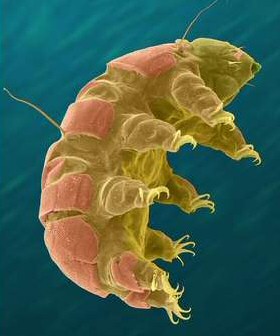
It is from these lichen tardigrades that scientists discovered their most intriguing feature. The tardigrades have the capability to survive in the most extreme of environments. Lichens and Mosses are regularly exposed to drying heat and sunlight. When this happens, the "water bear" can dry itself up and cease all living functions, only to spring back to life when rehydrated, even years later. They can survive for up to ten years without water by doing this! It is called "CRYPTOBIOSIS." They can last at near absolute zero temperatures, and up to 303 degrees Fahrenheit. They are also able to take 1000 times more radiation than any other known animal.

It gets even weirder. Tardigrades are "EUTELIC" animals. Eutelic animals are creatures that, upon reaching maturity, all have the exact same number of cells in their bodies. Think about how weird this is. Once they mature, cell division stops, and the creature can only grow by cell enlargement. Most Eutelic animals are microscopic of course. Some of these teeny animals are predatory and hunt other microorganisms.

Now for the kicker. These animals can survive in the cold vacuum of space!
In September 2008, a space launch showed that tardigrades can survive the
extreme environment of outer space for 10 days.
After being rehydrated back on earth, over 68% of the subjects protected from
high-energy UV radiation survived and many of these produced viable embryos, and a handful survived full exposure to the sun.
The amount of cold and heavy radiation/cosmic rays these animals were exposed to would kill any mammal. Even the few that had direct exposure to the Sun's harmful radiation had survivors, who appeared fully normal upon return to Earth!
Incredible!

How to Find Terrestrial Tardigrades
-Collect a clump of moss or lichen (dry or wet) and place in a shallow dish, such as a Petri dish.
-Soak in water (preferably rainwater or distilled water) for 3-24 hours.
-Remove and discard excess water from the dish.
-Shake or squeeze the moss/lichen clumps over another transparent dish to collect trapped water.
-Starting on a low objective lens, examine the water using a stereo microscope.
-Use a micropipette to transfer tardigrades to a slide, which can be observed with a higher power under a compound microscope. (from Microbial Life website)