Ahh, the Solar Prominence. These amazing expulsions of stellar matter have been captured often by our Sun-orbiting satellites. This one is an exceptionally large one. According to the good folks at Astronomy Picture Of The Day, this prominence is so large that the Earth could easily fit underneath the arc of matter being expelled! Amazing!
LARGE SOLAR PROMINENCE

Showing posts with label Astronomy. Show all posts
Showing posts with label Astronomy. Show all posts
Mar 11, 2011

Dec 15, 2010
-FUPPETS- Loves Solar Prominences
-FUPPETS- cannot get enough astronomy. There is an infinity of discoveries to be made. Check out this great short video of a large solar prominence captured by the Solar Dynamics Observatory.
SOLAR PROMINENCE
Here is APOD's description of the video.
SOLAR PROMINENCE
Here is APOD's description of the video.
"...an unusually long filament explode out from the Sun. The filament had been seen hovering over the Sun's surface for over a week before it erupted earlier this month. The image sequence was taken by the Earth-orbiting Solar Dynamics Observatory (SDO) in a color of ultraviolet light specifically emitted by helium. The explosion created Coronal Mass Ejections which dispersed high energy plasma into the Solar System. This plasma cloud, though, missed the Earth and so did not cause auroras."
Sep 20, 2010
-FUPPETS- Loves Time-Lapse Photography!
Timelapse Montage from Mike Flores on Vimeo.
The above video shows the sky as the Earth rotates, providing a great sped-up view of the heavens above our beautiful planet.
Apr 23, 2010
-FUPPETS- Loves Solar Prominences!!!
The movie below is from the newly launched SOLAR DYNAMICS OBSERVATORY. This new telescope will send back 1.5 terabytes of data a day! Solar prominences are the result of the Sun's intense magnetic field ejecting matter as the field twists and warps itself, due to the liquidity of the matter that makes up the Sun.
Soon after the instruments opened their doors, the Sun began performing for SDO with this beautiful prominence eruption. This AIA data is from March 30, 2010, showing a wavelength band that is centered around 304 �. This extreme ultraviolet emission line is from singly ionized Helium, or He II, and corresponds to a temperature of approx. 50,000 degrees Celsius.
Mar 31, 2010
What Do 10 Million Stars Look Like?
-FUPPETS- has the answer. From the good people at NASA's Astronomy Picture of The Day, here is a very crisp telescopic image of the globular star cluster Omega Centauri (named NGC 5139). Click the image below to enlarge.
Globular star clusters are large groups of stars that orbit around the edges of galaxies. This particular one orbits around our Milky Way galaxy, along with hundreds of others. Omega Centauri is the brightest and most densely packed of all the known star clusters. One strange thing about this star cluster is that it is far older than the other star clusters, with an approximate age of 12 billion years. It is also so densely packed in it's center that the stars there are less than .1 light year apart. That is ridiculously close by outer space standards. Just for comparison, the closest detected star to our Sun is Proxima Centauri, a red dwarf star approximately 4.2 light years away. If you happened to live on a world orbiting a star near Omega Centauri's center, it is likely you would never experience night, or what Earthlings consider night. The vast amount of nearby stars would ensure that even at "nighttime" the sky would never go dark. It is possible that even individual stars would not be discernible, just a flat field of light in the sky at all times. -FUPPETS- wonders what kind of mythology a species would develop without nighttime stars and celestial objects to ponder?

Globular star clusters are large groups of stars that orbit around the edges of galaxies. This particular one orbits around our Milky Way galaxy, along with hundreds of others. Omega Centauri is the brightest and most densely packed of all the known star clusters. One strange thing about this star cluster is that it is far older than the other star clusters, with an approximate age of 12 billion years. It is also so densely packed in it's center that the stars there are less than .1 light year apart. That is ridiculously close by outer space standards. Just for comparison, the closest detected star to our Sun is Proxima Centauri, a red dwarf star approximately 4.2 light years away. If you happened to live on a world orbiting a star near Omega Centauri's center, it is likely you would never experience night, or what Earthlings consider night. The vast amount of nearby stars would ensure that even at "nighttime" the sky would never go dark. It is possible that even individual stars would not be discernible, just a flat field of light in the sky at all times. -FUPPETS- wonders what kind of mythology a species would develop without nighttime stars and celestial objects to ponder?
The image below is a tight close-up of the core of Omega Centauri. Click image for a larger version.

Most scientists think that Omega Centauri exists as the end result of an old galaxy colliding with the Milky Way, and scientists reported in 2008 that they have apparently detected a mid-sized black hole at it's center, which would also point to a galactic collision in the distant past as the cause of it's creation. It is hard to imagine that something so massive, with over ten million stars in it, is just a dwarf companion to our own galaxy. The Milky Way is also just a medium sized galaxy. There are galaxies out there with ten times the number of stars that our galaxy has. It is just a mind-boggling number and quite a humbling thing to ponder.
Mar 30, 2010
-FUPPETS- Loves Science!
The Large Hadron Collider has finally managed to collide the beams inside it. This is very exciting. As with any massive undertaking, there were several kinks to work out, as well as system failures to correct. Since November 2009 the LHC has been sending it's energy beams at ever faster speeds and ever higher energy levels. They plan to run the collisions constantly for almost 2 years. In those two years the amount of scientific data that will be gained will seem so massive, it will take scientists and researchers decades to analyze it all. The video below details some of the issues the LHC has had in the 18 months since it went online.
As readers of -FUPPETS- know, -FUPPETS- and Astronomy go together like Ice T and Coco Austin. Astronomy is possibly the oldest scientific field, and yet it is still the one where intelligent amateurs can contribute in meaningful ways. Sometimes backyard astronomers discover new comets, or help do stellar cartography. Sometimes, like Robert Harrison explains in the video below, these amateur astronomers figure out novel ways to capture images of our planet and of space. Robert Harrison sent a camera with balloons up to 22 miles above the Earth to take spectacular images.
As readers of -FUPPETS- know, -FUPPETS- and Astronomy go together like Ice T and Coco Austin. Astronomy is possibly the oldest scientific field, and yet it is still the one where intelligent amateurs can contribute in meaningful ways. Sometimes backyard astronomers discover new comets, or help do stellar cartography. Sometimes, like Robert Harrison explains in the video below, these amateur astronomers figure out novel ways to capture images of our planet and of space. Robert Harrison sent a camera with balloons up to 22 miles above the Earth to take spectacular images.
Feb 2, 2010
Asteroid Collision Caught By Hubble Space Telescope
The amazing and now-venerable Hubble Space Telescope has captured an image of an event that, while an extremely common occurrence in our Solar System, has never been caught on camera before by any of our instruments.
Our Solar System has a band of rocks and debris termed the Asteroid Belt, which is located between the orbits of Mars and Jupiter. In this belt there exist countless millions of rocks and aggregate boulders, each spinning around our Sun in their own orbit. Oftentimes, these asteroids glance off of one another, disrupting their orbits. Recently there has been much talk about near-Earth asteroids tracked by NASA and other space agencies. These asteroids all come from the asteroid belt, and are knocked off their orbits and toward our planet's orbit, by collisions such as the one captured by the Hubble.
On January 25th and then again on the 29th, the Hubble Space Telescope captured this striking image. (click image to enlarge)
Below is the close-up of the image. (click image to enlarge)
What appears to be a drooping "X" shape on the left of the image is the end result of the collission.
Even with the relatively crowded asteroid belt's many inhabitants, capturing an image of a collision is an amazing feat. -FUPPETS- continues to be astounded by the magnificence of the human scientific endeavor.
Can you imagine being asked to point out something just 460 feet in diameter from about 2.7 AU away?
Our Solar System has a band of rocks and debris termed the Asteroid Belt, which is located between the orbits of Mars and Jupiter. In this belt there exist countless millions of rocks and aggregate boulders, each spinning around our Sun in their own orbit. Oftentimes, these asteroids glance off of one another, disrupting their orbits. Recently there has been much talk about near-Earth asteroids tracked by NASA and other space agencies. These asteroids all come from the asteroid belt, and are knocked off their orbits and toward our planet's orbit, by collisions such as the one captured by the Hubble.
On January 25th and then again on the 29th, the Hubble Space Telescope captured this striking image. (click image to enlarge)

Below is the close-up of the image. (click image to enlarge)

What appears to be a drooping "X" shape on the left of the image is the end result of the collission.
Astronomers have long thought the asteroid belt is being ground down because of collisions, but such a head-on crash had never been seen before.
"If this interpretation is correct, two small and previously unknown asteroids recently collided, creating a shower of debris that is being swept back into a tail from the collision site by the pressure of sunlight," said principal investigator David Jewitt, from the University of California at Los Angeles.
At first, astronomers thought what they saw might be a main belt comet, a rare case of a comet orbiting while in the asteroid belt.
But the images taken by Hubble revealed the complex X-pattern of filamentary structures near the object's nucleus.
Jewitt said the filaments are made of dust and gravel. Some of them are being swept back by radiation pressure from sunlight, creating the long, straight dust streaks, he said.
The nucleus of the presumed boom is 460 feet in diameter, NASA said. ( CNN )
Even with the relatively crowded asteroid belt's many inhabitants, capturing an image of a collision is an amazing feat. -FUPPETS- continues to be astounded by the magnificence of the human scientific endeavor.
Can you imagine being asked to point out something just 460 feet in diameter from about 2.7 AU away?
Jan 27, 2010
Is SONIC YOUTH Prophetic?
-FUPPETS- House Band, SONIC YOUTH, have always been known for their skronk, and their artsy-fartsy-ness, both of which -FUPPETS- requires. The one thing that Sonic Youth has not been known for is prophetic powers, but that may soon change.
StevOK, one of the stalwart sonic mystics over at the Sonic Youth Gossip Forum, has provided -FUPPETS- with possible evidence of this prophetic ability. One o the most beloved, and also one of the longest, songs that Sonic Youth have released is a track called The Diamond Sea. It is a magnificent track, with a 20 minute long noise/skronk/skree coda to end the damn thing. It is a mindfuck for sure.
-FUPPETS- has long held this song to be an allusion to the state of marriage, but StevOK has provided -FUPPETS- with some interesting possibilities.
The planets Neptune and Uranus may actually have oceans of liquid diamond! Amazing! The image above is of Neptune.
Oceans of liquid diamond, containing "icebergs" of solid diamond, sounds like an insane idea, but the kicker is that this property of diamond would help explain why the magnetic fields of Neptune and Uranus appear to be, from our vantage point, skewed very far off their north/south axis. Diamond, especially diamond in a liquid state, is quite a powerful magnetic resonator.
To verify this will take an un-manned exploratory vehicle to head out to the planets and actually land on them, in order to physically test this theory. A trip such as that would take around 10 years for a vehicle to make. -FUPPETS- proposes that, if this vehicle is indeed built and launched, it be named the Sonic Youth, in honor of the prophetic musical geniuses -FUPPETS- loves.
In honor of this possibility, -FUPPETS- brings you the one and only Sonic Youth, performning The Diamond Sea live on French television.
SONIC YOUTH - The Diamond Sea
StevOK, one of the stalwart sonic mystics over at the Sonic Youth Gossip Forum, has provided -FUPPETS- with possible evidence of this prophetic ability. One o the most beloved, and also one of the longest, songs that Sonic Youth have released is a track called The Diamond Sea. It is a magnificent track, with a 20 minute long noise/skronk/skree coda to end the damn thing. It is a mindfuck for sure.
-FUPPETS- has long held this song to be an allusion to the state of marriage, but StevOK has provided -FUPPETS- with some interesting possibilities.

The planets Neptune and Uranus may actually have oceans of liquid diamond! Amazing! The image above is of Neptune.
Scientists zapped diamond with a laser at pressures 40 million times greater than the Earth's atmosphere at sea level, and then slowly reduced both temperature and pressure. They eventually found that diamond behaves like water during freezing and melting, and that chunks of diamond will float in the liquid diamond. - ( Jeremy Hsu - PopSci )
Oceans of liquid diamond, containing "icebergs" of solid diamond, sounds like an insane idea, but the kicker is that this property of diamond would help explain why the magnetic fields of Neptune and Uranus appear to be, from our vantage point, skewed very far off their north/south axis. Diamond, especially diamond in a liquid state, is quite a powerful magnetic resonator.
To verify this will take an un-manned exploratory vehicle to head out to the planets and actually land on them, in order to physically test this theory. A trip such as that would take around 10 years for a vehicle to make. -FUPPETS- proposes that, if this vehicle is indeed built and launched, it be named the Sonic Youth, in honor of the prophetic musical geniuses -FUPPETS- loves.
In honor of this possibility, -FUPPETS- brings you the one and only Sonic Youth, performning The Diamond Sea live on French television.
SONIC YOUTH - The Diamond Sea
Jan 20, 2010
-FUPPETS- Video Of The Day: THE KNOWN UNIVERSE
-FUPPETS- loves science. Everyone knows this. -FUPPETS- loves how a seemingly simple method of gathering data about the universe around us has expanded the human potential to unfathomable reaches. The times humanity is currently living through are the most expansive, exploratory, scientifically rich times in the history of our species. There are more scientists exploring more subjects and gathering more data than at any point in our existence.
One of the fields in which our knowledge is expanding near-exponentially is the field of Astronomy. This may be the oldest field of human exploration, for all that was needed of our ancient ancestors was a pair of good eyes, and the time to gaze up at the heavens.
The good people over at the American Museum of Natural History have pondered the question, "What if we could travel the entire known Universe?" They have used all the data at their disposal to create this amazing animated movie. Not only does this accurately recreate a trip through our Universe, all the way to what is now seen as the Cosmic Microwave Background Radiation, but everything is set to scale, as close as our best scientific data can surmise.
One of the fields in which our knowledge is expanding near-exponentially is the field of Astronomy. This may be the oldest field of human exploration, for all that was needed of our ancient ancestors was a pair of good eyes, and the time to gaze up at the heavens.
The good people over at the American Museum of Natural History have pondered the question, "What if we could travel the entire known Universe?" They have used all the data at their disposal to create this amazing animated movie. Not only does this accurately recreate a trip through our Universe, all the way to what is now seen as the Cosmic Microwave Background Radiation, but everything is set to scale, as close as our best scientific data can surmise.
Dec 8, 2009
Farther in Time and Distance Than Humanity Has Ever Seen!
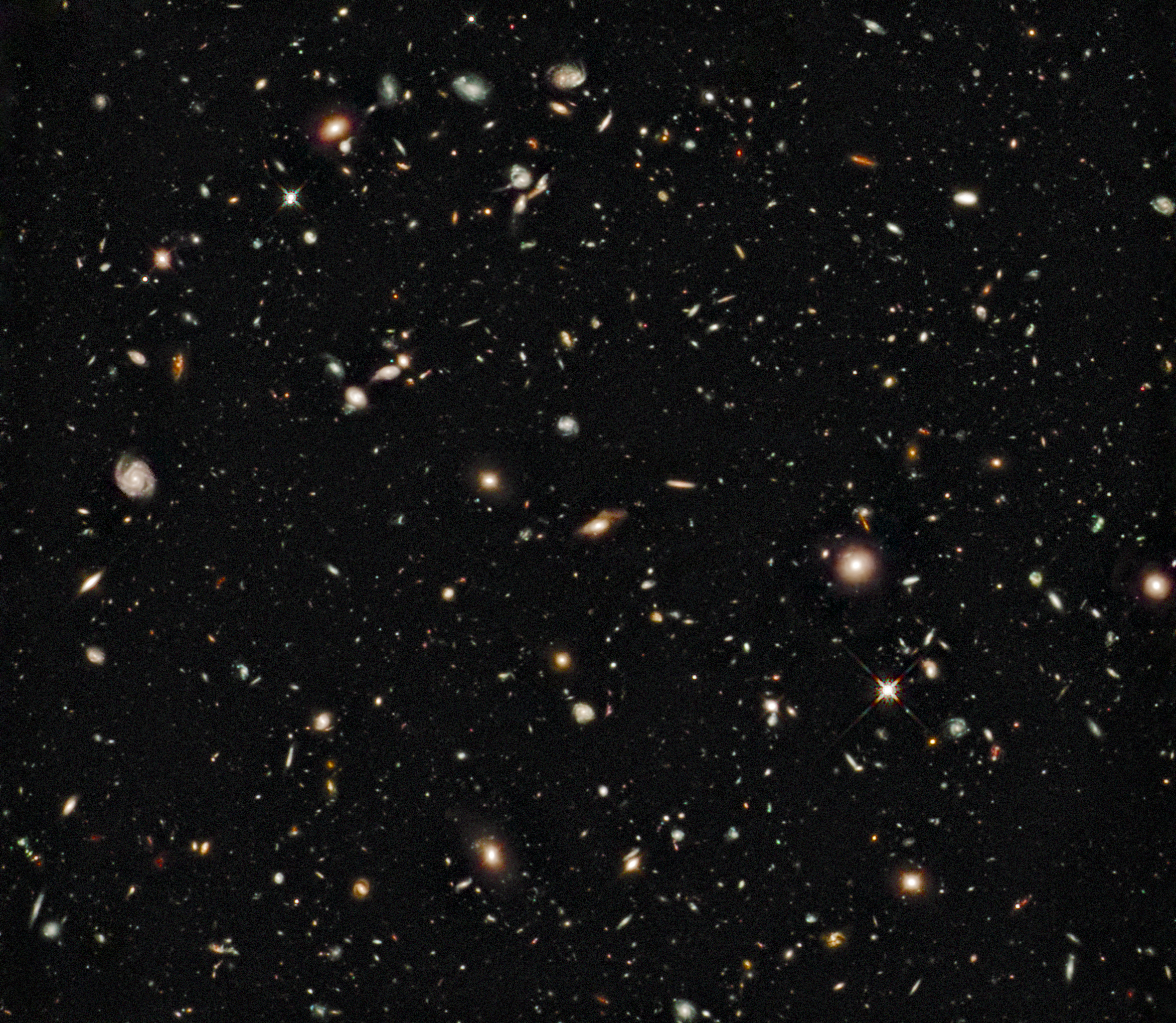
One of the most astounding accomplishments of the Hubble were the images called the Hubble Deep Field and the Ultra Deep Field images. These images were taken in 2004 by pointing the Hubble at what appeared to be a relatively empty region of deep space, zooming in, then finding the emptiest part of that deep image, and zooming in yet again. What was found blew the world's mind. More galaxies! Insanity! The Universe is so vast, so confoundingly enormous, that nothing in our human-scale set of reference points can help us visualize it properly. This is the Ultra Deep Field Image.

The first image above was taken this year, at a distance correlating with a time just 800-900 million years after the Big Bang. WOW! (Click on the top image to see the LARGE version. Galaxies, island universes all, abound.)
The photo was taken with the new WFC3/infrared camera on Hubble in late August 2009, during a total of four days of pointing for 173 000 seconds of total exposure time. Infrared light is invisible to the human eye and therefore does not have colours that can be perceived. The representation is "natural" in that shorter infrared wavelengths are represented as blue and the longer wavelengths as red. The faintest objects are about one billion times fainter than the dimmest visible objects seen with the naked eye. - ( Science Daily )
That means that over four days they created a 47 hour exposure! That is some super-faint light! The red-shift on these is immense. To imagine the awe that would be felt by someone such as Copernicus, or even Albert Einstein at these magnificent images. These images say far more about the wonder, skill, and glorious beauty of humanity than most people give them credit for.
-FUPPETS- says LONG LIVE SCIENCE!
Nov 12, 2009
NASA Unveils Plan to Free the Mars Rover SPIRIT!
It has been months in the making, and countless theories and possibilities brainstormed, but NASA has announced that it has a plan in place to begin what will hopefully accomplish the extraction of the Mars Rover SPIRIT from the "quicksand" trap it has been embedded in.
The "soil" is so fine it more closely resembles talcum powder than what we could call sand or dirt.
Click HERE to see a full circle panorama of Spirit's current location.
Click HERE to see a large image detailing the path of the Mars Rover SPIRIT since arriving at the plateau designated "Home Plate." The yellow line marks the path taken, and you can see the location of SPIRIT's current predicament, labelled "Troy."
They will begin to run the extraction program on Monday. Scientists expect it to be a painstakingly slow process, but little by little, they hope to once again have SPIRIT roaming free on Mars. Even if the worst occurs, and they are not able to extract SPIRIT from it's sandy trap, the area where it is located is highly rich in geological oddities, and much good science could still be done. -FUPPETS- hopes it does not come to that!

The "soil" is so fine it more closely resembles talcum powder than what we could call sand or dirt.
Click HERE to see a full circle panorama of Spirit's current location.

Click HERE to see a large image detailing the path of the Mars Rover SPIRIT since arriving at the plateau designated "Home Plate." The yellow line marks the path taken, and you can see the location of SPIRIT's current predicament, labelled "Troy."

They will begin to run the extraction program on Monday. Scientists expect it to be a painstakingly slow process, but little by little, they hope to once again have SPIRIT roaming free on Mars. Even if the worst occurs, and they are not able to extract SPIRIT from it's sandy trap, the area where it is located is highly rich in geological oddities, and much good science could still be done. -FUPPETS- hopes it does not come to that!
Nov 4, 2009
Enceladus, and it's water geysers, rocks -FUPPETS-
NASA's Cassini Spacecraft has been in orbit around Saturn for 5 years now. It has provided humanity with some of the most strikingly beautiful images of everyone's favorite denizen of the Solar System, Saturn, as well as it's myriad moons. Constant streams of raw data are sent from Cassini to Earth for scientist's and fanatics such as -FUPPETS- to drool over.
On November 2nd, Cassini made it's closest approach to one of the most intriguing bodies in our Solar System, Saturn's moon Enceladus. The reason Enceladus is so amazing is that it is the one place in our Solar System where liquid water has been conclusively found. The greatest part is how it was found. Enceladus has massive geysers of water erupting from it's icy surface! Cassini discovered these plumes, and has now actually gotten close enough to pass though the outer reaches of one of these immense geysers, just over 100 miles away from the surface of the moon itself.
Cassini shot by Enceladus at 7.7 kilometers per second, or 17,200 miles per hour.
In this raw image, one can see one of the massive plumes, back-lit by the sun, as Cassini approaches Enceladus. (click the image to enlarge to full resolution)
Scientists have previously detected water vapor, sodium, and organic molecules in the jets, but this flyby will actually allow the Cassini spacecraft to take up-close readings of the chemical composition of these jets.
Pictured below is another shot of Enceladus, displaying what appear to be multiple geyser jets. (click on image to enlarge)
In 16 days there will be another fly-by of Enceladus by Cassini. -FUPPETS- cannot wait to see what bad-assitude Cassini will spring upon us next!
On November 2nd, Cassini made it's closest approach to one of the most intriguing bodies in our Solar System, Saturn's moon Enceladus. The reason Enceladus is so amazing is that it is the one place in our Solar System where liquid water has been conclusively found. The greatest part is how it was found. Enceladus has massive geysers of water erupting from it's icy surface! Cassini discovered these plumes, and has now actually gotten close enough to pass though the outer reaches of one of these immense geysers, just over 100 miles away from the surface of the moon itself.
Cassini had approached Enceladus more closely before, but this passage took the spacecraft on its deepest plunge yet through the heart of the plume shooting out from the south polar region. Scientists are eagerly sifting through the results. - ( Space.com )
Cassini shot by Enceladus at 7.7 kilometers per second, or 17,200 miles per hour.
In this raw image, one can see one of the massive plumes, back-lit by the sun, as Cassini approaches Enceladus. (click the image to enlarge to full resolution)

Scientists have previously detected water vapor, sodium, and organic molecules in the jets, but this flyby will actually allow the Cassini spacecraft to take up-close readings of the chemical composition of these jets.
Pictured below is another shot of Enceladus, displaying what appear to be multiple geyser jets. (click on image to enlarge)

In 16 days there will be another fly-by of Enceladus by Cassini. -FUPPETS- cannot wait to see what bad-assitude Cassini will spring upon us next!
Oct 30, 2009
3,000 Images Used to Make Panorama of the Milky Way!
Oh how -FUPPETS- loves astronomy. The world's oldest science is also it's most technologically advanced, and this provides -FUPPETS- with many occasions to love on the sights and wonders of outer space.
Dr. Axel Mellinger, of Central Michigan University, has used intricate mathematical models and over 3,000 images to create this PANORAMA OF THE MILKY WAY. ( <--- click to see the image ) What a beautiful thing. In today's world, most people live in cities. These cities are all illuminated artificially at night so most people in the world do not live day to day (or night to night) with the full spread of the Milky Way galaxy overhead. This used to be a constant companion to mankind, but ever since Thomas Edison crafted his filament and incandescent bulb, humans have brightened the night and dimmed the stars. The immense corrections needed to combine all these images are mind-boggling.
AMAZING!
Since -FUPPETS- is talking about the Milky Way, here is a fitting video for you to enjoy.
THE CHURCH - Under The Milky Way
Dr. Axel Mellinger, of Central Michigan University, has used intricate mathematical models and over 3,000 images to create this PANORAMA OF THE MILKY WAY. ( <--- click to see the image ) What a beautiful thing. In today's world, most people live in cities. These cities are all illuminated artificially at night so most people in the world do not live day to day (or night to night) with the full spread of the Milky Way galaxy overhead. This used to be a constant companion to mankind, but ever since Thomas Edison crafted his filament and incandescent bulb, humans have brightened the night and dimmed the stars. The immense corrections needed to combine all these images are mind-boggling.

To combine these images, a simple cutting and pasting job would not suffice. Each photograph is a two-dimensional projection of the celestial sphere. As such, each one contains distortions, in much the same way that flat maps of the round Earth are distorted. In order for the images to fit together seamlessly, those distortions had to be accounted for. To do that, Mellinger used a mathematical model — and hundreds of hours in front of a computer.
Another problem he had to deal with was the differing background light in each photograph.
"Due to artificial light pollution, natural air glow, as well as sunlight scattered by dust in our solar system, it is virtually impossible to take a wide-field astronomical photograph that has a perfectly uniform background," Mellinger said.
To fix this, Mellinger used data from the Pioneer 10 and 11 space probes. The data allowed him to distinguish star light from unwanted background light. He could then edit out the varying background light in each photograph and fit them together so that they wouldn't look patchy. - ( Space.com )
AMAZING!
Since -FUPPETS- is talking about the Milky Way, here is a fitting video for you to enjoy.
THE CHURCH - Under The Milky Way
Oct 21, 2009
Exoplanets All Over The Place
Recently, the announcement of a European exoplanet search discovering over thirty new planets orbiting stellar systems other than our own caused much sensation. Using extremely precise instruments capable of determing minute rotational "wobbles" in distant stars, the managed to find exoplanets much smaller, and hopefully rocky like the Earth, than the gas giant planets first found with this method.
This makes more than 400 known exoplanets. Just twenty years ago it was pure science fiction that we could detect actual planets around distant stars, stars whose brightness overwhelms anything orbiting around it (unless it is a twin-star system!).
Just the other day NASA researchers announced their discovery of organic molecules in the atmosphere of a gas planet, the second such planet they have found. That makes two planets outside of our solar system in which the basic chemical ingrediants of life have been detected, water, methane and carbon dioxide. That may not sound like much but being able to detect these chemical pattersn should one day help us accurately detect smaller, earth-like exoplanets.
For a Flash animated timeline of humanity's history of planet and then exoplanet hunting check THIS from NASA. Good stuff.
This makes more than 400 known exoplanets. Just twenty years ago it was pure science fiction that we could detect actual planets around distant stars, stars whose brightness overwhelms anything orbiting around it (unless it is a twin-star system!).
Just the other day NASA researchers announced their discovery of organic molecules in the atmosphere of a gas planet, the second such planet they have found. That makes two planets outside of our solar system in which the basic chemical ingrediants of life have been detected, water, methane and carbon dioxide. That may not sound like much but being able to detect these chemical pattersn should one day help us accurately detect smaller, earth-like exoplanets.
For a Flash animated timeline of humanity's history of planet and then exoplanet hunting check THIS from NASA. Good stuff.
Oct 20, 2009
Solar Prominence Eruption Captured on Video
Solar Prominences are amazing ejections of solar matter caused by the ever-changing magnetic field of the Sun. These events launch millions of tons of material away from the sun, and can sometimes result in very damaging electrical storms once the ejecta makes it's way to the Earth and collide with the earth's own magnetic field.
The twin STEREO spacecraft have captured one such ejection. The STEREO spacecraft are two separate but identical satellites which are positioned one WAY in front and one WAY behind the Earth as it orbits around the Sun, so, in essence, they follow the same orbit path as us. By positioning these instruments there, it is possible to capture a stereoscopic vision of solar prominences and ejecta, as well as any other solar events that may occur. Enjoy the short clip below.
The twin STEREO spacecraft have captured one such ejection. The STEREO spacecraft are two separate but identical satellites which are positioned one WAY in front and one WAY behind the Earth as it orbits around the Sun, so, in essence, they follow the same orbit path as us. By positioning these instruments there, it is possible to capture a stereoscopic vision of solar prominences and ejecta, as well as any other solar events that may occur. Enjoy the short clip below.
Sep 15, 2009
Interesting Finds Regarding Galactic Centers
-FUPPETS- loves galaxies. Oh yes. Galaxies, or "island universes," are what compose much of the matter in our visible Universe. In our very own Galaxy, dubbed the "Milky Way," there are upwards of a billion different stars, with thousands "born" out of the interstellar dust constantly, as seen below in this image of a stellar "nursery."
For our entire history, humans have gazed at the band of stars and dust that crosses our sky. Ever since Kepler's time, when we have known that we are in one galaxy which is a part of a bigger universe composed of billions of other galaxies, humans have tried to see the galactic center, to wonder what exactly resides there. The galactic center is obscured by dust clouds thousands of light years across. In our recent history it has been discovered that most galaxies have a very large black hole at the center. Ours appears to be no different.
The bright white spot towards the middle of the above image is a star cluster of several million stars located at the center of our galaxy, and it is believed this cluster surrounds a super-massive black hole. For the past few decades it was assumed that this is the case for most all galaxies. Scientists at The Swinburne University of Technology, however, have found otherwise.
The researchers at Swinburne concentrated on 50 regular galaxies to determine their composition. (Regular galaxies have well defined arms and spirals and are more prevalent. Irregular galaxies are more like fuzzy clouds.)
Smaller galaxies were expected to contain a star cluster at their center, while larger galaxies were expected to have a super-massive black hole at the center. Finding 12 out of 50 to have TWO nuclei was a shock. In these galaxies, a super-massive black hole spins around a massive star cluster, each pulling on the other, and collectively providing the gravitation that holds the galaxies together. Amazing stuff. This opens up the possibility of very violent cosmological occurrences!
Maybe our instruments will soon witness such an amazing thing. -FUPPETS- is psyched.

For our entire history, humans have gazed at the band of stars and dust that crosses our sky. Ever since Kepler's time, when we have known that we are in one galaxy which is a part of a bigger universe composed of billions of other galaxies, humans have tried to see the galactic center, to wonder what exactly resides there. The galactic center is obscured by dust clouds thousands of light years across. In our recent history it has been discovered that most galaxies have a very large black hole at the center. Ours appears to be no different.

The bright white spot towards the middle of the above image is a star cluster of several million stars located at the center of our galaxy, and it is believed this cluster surrounds a super-massive black hole. For the past few decades it was assumed that this is the case for most all galaxies. Scientists at The Swinburne University of Technology, however, have found otherwise.
The researchers at Swinburne concentrated on 50 regular galaxies to determine their composition. (Regular galaxies have well defined arms and spirals and are more prevalent. Irregular galaxies are more like fuzzy clouds.)
The researchers, Associate Professor Alister Graham and Dr Lee Spitler, found that 12 of these galaxies contained a double nucleus -- that is, they had both a super massive black hole and a dense star cluster containing up to ten million stars at their centre. - ( Science Daily )
Smaller galaxies were expected to contain a star cluster at their center, while larger galaxies were expected to have a super-massive black hole at the center. Finding 12 out of 50 to have TWO nuclei was a shock. In these galaxies, a super-massive black hole spins around a massive star cluster, each pulling on the other, and collectively providing the gravitation that holds the galaxies together. Amazing stuff. This opens up the possibility of very violent cosmological occurrences!
“When stars get too close to massive black holes, the gravitational attraction is such that they can be devoured,” Graham said. “When you’ve got up to a million stars within the immediate vicinity of a black hole, the chance of this occurring increases significantly.”
The predominance of double nucleus galaxies also means there are likely to be many more ‘hyper velocity stars’ in existence than astronomers had thought.
“This is when a star approaches a massive black hole and gets caught in a gravitational slingshot. When this happens stars can be ejected from galaxies at speeds in excess of 500 kilometres per second,” Graham said.
Another implication of the research – and according to the researchers one of the most exciting – is the increased likelihood of the phenomenon known as gravitational radiation.
“Such emission has been predicted by Einstein’s General Theory of Relativity, but has never been observed,” said Spitler. “It is theorised that when stars spiral quickly around a black hole the motion will create gravitational waves – causing ripples in the space-time continuum.”
The Laser Interferometer Space Antenna (LISA) – a suite of three satellites spaced five million kilometres apart and planned for launch in 2018 – is being designed to search for such ripples as they pass through our solar system.
Maybe our instruments will soon witness such an amazing thing. -FUPPETS- is psyched.
Jul 6, 2009
The Coldest Object in Space is Man-Made
-FUPPETS- is always amazed at the incredible ingenuity of humanity. The Planck Telescope is in space and contains several instruments. One of these, the Planck Telescope's High Frequency Instrument, reached it's coldest temperature on July 2nd.
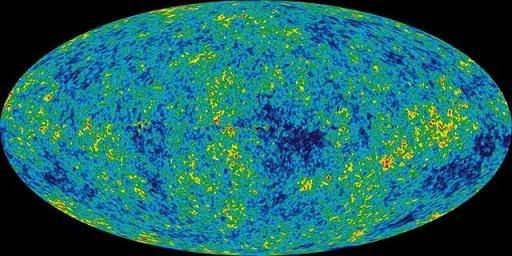
The High Frequency Instrument needs to be at -273 Celsius in order to perform it's intended function, which is to capture radiation from the Big Bang, the Cosmic Microwave Background, radiation which is maybe half a degree warmer than the -273 °C temperature that the Instrument has achieved. This was done with a passive cooling system which radiates heat out into space and got the temperature down to -230 °C, after which three active cooling units lowered the temperature of the instruments to 273.05°C, only 0.1°C above absolute zero! That is amazingly cold, and almost as cold as theoretically possible. Any colder and the atomic motion of the instrument itself would stop completely.
Here is an image of the Cosmic Background Radiation, in the best resolution we have. The Planck telescope will achieve a much higher resolution.
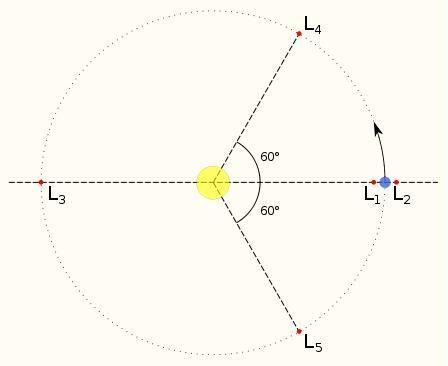
Another achievement of the Plank Telescope was reached on the same day. Just before noon that day, the telescope reached L2, The second Lagrangian point of the Sun/Earth system.
Lagrangian points are points in a two mass system where a third mass appears stationary in relation to the previous two masses, in this case the Earth and our sun, Sol.
Here is a diagram of the 5 LaGrangian Points in relation to the Earth and Sol.
The High Frequency Instrument needs to be at -273 Celsius in order to perform it's intended function, which is to capture radiation from the Big Bang, the Cosmic Microwave Background, radiation which is maybe half a degree warmer than the -273 °C temperature that the Instrument has achieved. This was done with a passive cooling system which radiates heat out into space and got the temperature down to -230 °C, after which three active cooling units lowered the temperature of the instruments to 273.05°C, only 0.1°C above absolute zero! That is amazingly cold, and almost as cold as theoretically possible. Any colder and the atomic motion of the instrument itself would stop completely.
Here is an image of the Cosmic Background Radiation, in the best resolution we have. The Planck telescope will achieve a much higher resolution.
Another achievement of the Plank Telescope was reached on the same day. Just before noon that day, the telescope reached L2, The second Lagrangian point of the Sun/Earth system.
Lagrangian points are points in a two mass system where a third mass appears stationary in relation to the previous two masses, in this case the Earth and our sun, Sol.
For example, given two massive bodies in circular orbits around their common
center of mass, there are five positions in space where a third body, of comparatively negligible mass, could be placed which would then maintain its position relative to the two massive bodies. - ( Science Daily )
Here is a diagram of the 5 LaGrangian Points in relation to the Earth and Sol.
Jun 29, 2009
Japan's KAGUYA Spacecraft smashes into Moon (on purpose)
The video above is an astounding motion picture taken by Japan's Kaguya Spacecraft, as it neared it's destination, a crash-landing inside a crater on the Moon's Northern Pole.
The Kaguya Spacecraft was launched on September 14, 2007 and it's main orbiter circled the moon for a year and 8 months, taking high-definition images of the Moon's topography. The plan for the end of the mission was to have it collide on purpose into a lunar crater, and to try and study the impact and whatever may be thrown out of the crater. The primary hope was to discover large amounts of subsurface ice.
The Kaguya craft was ordered to degrade it's orbit in February, and on June 10 it crash-landed on the Moon.
Officially named the Selenological and Engineering Explorer (SELENE), the spacecraft was given the nickname Kaguya after the princess in the Japanese folklore story The Tale of the Bamboo Cutter. - ( APOD )
The video is amazing and -FUPPETS- is ridiculously overjoyed to have seen it.
In April of this year, Kaguya captured a most-beautiful Earthrise over the horizon of the Moon.

Supreme ass-kickery.
Jun 22, 2009
Herschel Infrared Space Telescope Opens It's Eyes!
The largest Infrared telescope ever flown into outer space opened it's "eyes" on June 14th. The first object to be imaged by the Herschel's cameras is M51, the first spiral galaxy seen by Charles Messier in 1773.
The image above is a very preliminary image, taken just to show the intense resolution capabilities of this telescope's infrared astronomy capabilities. Blue indicates regions of warm dust that is heated by young stars, while the colder dust shows up in red. The image above was taken at three different infrared exposure levels, 70, 100, and 160 microns. Once the Herschel Space Observatory is fully commissioned, the incredible images will just begin to pour forth.
-FUPPETS- will be ready.
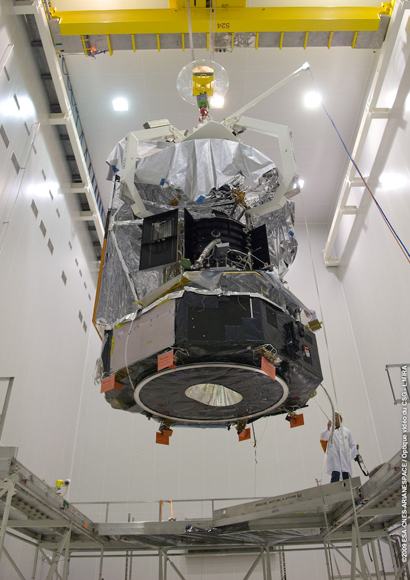
Here is an image of the Herschel Space Observatory after completion.

The image above is a very preliminary image, taken just to show the intense resolution capabilities of this telescope's infrared astronomy capabilities. Blue indicates regions of warm dust that is heated by young stars, while the colder dust shows up in red. The image above was taken at three different infrared exposure levels, 70, 100, and 160 microns. Once the Herschel Space Observatory is fully commissioned, the incredible images will just begin to pour forth.
-FUPPETS- will be ready.
Here is an image of the Herschel Space Observatory after completion.
May 18, 2009
This is not a fossilized Death Star. It is MIMAS!
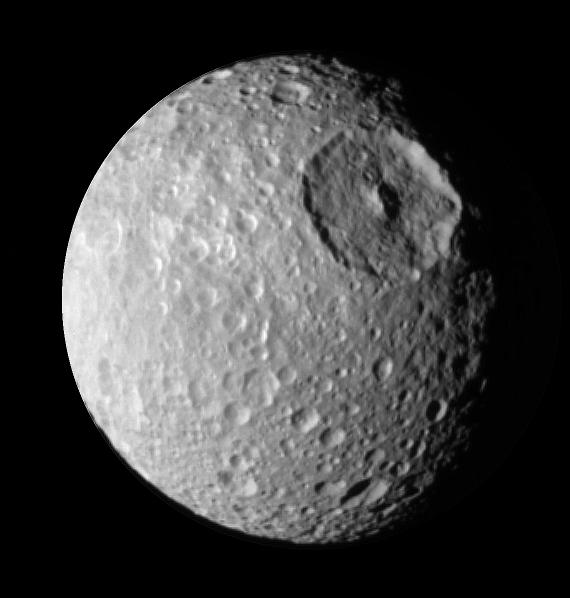
Mimas is one of Saturn's smallest moons, but it bears an uncanny resemblance to the Death Stars from the Star Wars movies. It was discovered in 1789 by astronomer extraordinaire William Herschel. The above image was taken by the spacecraft Cassini in 2005. Cassini now orbits around Saturn, keeping an eye on that most beautiful of planets, and giving us humans a perfect position from which to study the rings, moons, and surface storms of Saturn.
The strange thing about Mimas is that it is composed of mostly water ice, with a very small amount of rock dispersed throughout it. It is essentially one giant dirty snowball, and from the looks of that gigantic crater, spanning about 130 kilometers in diameter, it was almost destroyed by a very powerful collision.
The more we look at our Solar System the more we find the weirdest inhabitants of it. There are moons with volcanic activity rivaling that of the very early Earth. There are moons with volcanoes of liquid methane. There are planets barely big enough to be called a planet, and there are rings around many of the solar system's outer planets, not just Saturn. There are conditions which defy all expectations. What a wonderful world science shows us. -FUPPETS- loves that shit.
Subscribe to:
Posts (Atom)