Showing posts with label Astrogeology. Show all posts

Nov 2, 2009

MARS ROVER UPDATE

-FUPPETS- loves the Mars Rovers.

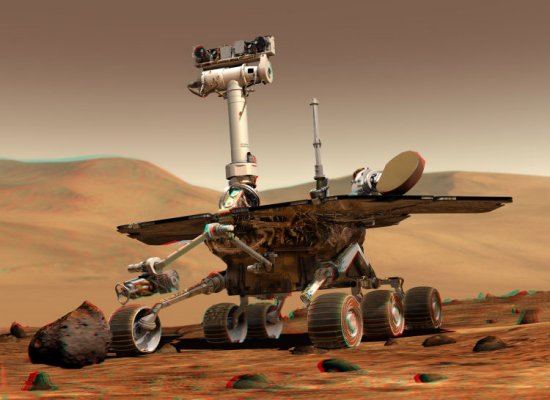
The Mars Rover named Spirit, stuck in deep Martian sands since April, is going through what scientists deem Amnesia events. The Flash memory that stores observational data for the Rover before it goes into it's nightly "hibernation" cycle is suffering from something, maybe power outages, that are not allowing the Rover to store data overnight during it's "sleep."
There are other data storage options on Spirit but they require the Rover to send all it's data to Earth before it goes into it's sleep cycle. Something similar occurred a few months ago.
NASA scientists have been using a Rover double to practice different techniques to extricate Spirit from it's sandy trap. It is a painstaking effort and hopefully it will pay off soon. The current problems with the memory have made this a tricky proposition.
Spirit and it's twin Opportunity have been roaming around on Mars since 2004. Originally slated to have a 90- day "life," these rovers are so very well constructed and engineered that they have managed to survive 6 Martian winters! -FUPPETS- loves that!

HERE is a great F.A.Q. for information on the two Rovers where Mars rover engineer Ashley Stroupe answers people's questions.

NASA also has a website entitled FREE SPIRIT, which is seeking any ideas to help extricate this Rover.
This is an image from earlier in October of the sand that Spirit is stuck in.

Mar 2, 2009

Chinese Lunar Probe Hits Moon

After mapping the Moon's surface for the past 16 months, the Chinese lunar satellite Chang'e 1 has been deliberately crashed onto the Moon's surface in what scientists are calling a controlled collision. Chang'e 1's mission was to map the entire surface of the Moon.


The Chinese government has announced plans to put a module into orbit and to have one of their space capsules dock with this module, called Tiangong-1, in preparations for a fully manned space station. In 2003 China became the third nation to put a manned vehicle into orbit around the Earth. They expect to launch the module sometime in 2010, and have tentative plans for a Moon mission in 2020. Amazing stuff.

Jan 5, 2009

-FUPPETS- Celebrates 5 year Anniversary of the Mars Exploration Rover Mission!


Our history of efforts with Martian spaceships is fraught with failure. Many of our spacecraft either are lost in flight, or have crashed into the Red Planet. Many of the missions that have survived the perils of intra-solar-system travel have been short lived. That is not the case any longer.
In what may very well be the single most successful and fruitful unmanned mission in the history of humanity, the two Mars Exploration Rovers, Spirit and Opportunity, are still kicking and rolling around the surface of mars, after FIVE YEARS! They have survived the harsh Martian winter 5 times, due to excellent engineering, painstaking construction, and inventive operations by the crews in charge of actually driving and programming the Rovers.
This is an amazing achievement, and one which is not being given enough praise in the regular news media, other than as a curiosity. -FUPPETS- is fucking amped up about this shit, you can be sure.
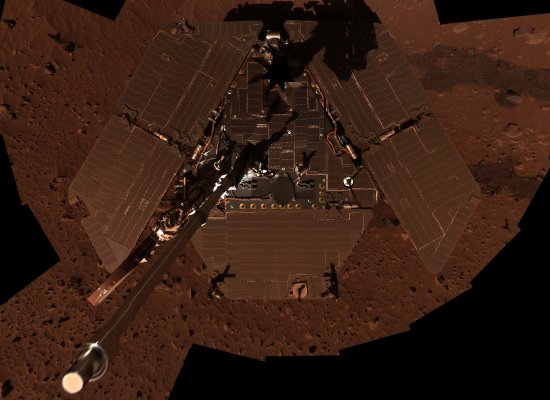
There have been mechanical issues, and one of the rovers is operating with just 4 of it's original 6 wheels, but the biggest issue the rovers have faced is one of dust. The Martian dust is very fine and covers the solar energy panels with a fine layer which obstructs the solar energy the rovers are dependent on. Below is an image of Spirit on it's one-year anniversary. You can see the layer of dust on it's solar panels.


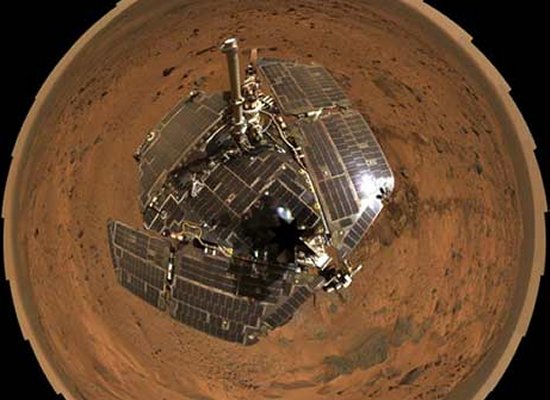
On the Moon, this would be fatal, but on Mars, which does have a tenuous atmosphere, occasional wind storms actually serve to clean off this dust! This was a purely lucky occurrence which the NASA scientists were overjoyed at experiencing. Without these random dust storms the rovers would have died a long time ago. At one point, Spirit was operating at less than 60% of the energy it normally needed, when, in a completely unexpected surprise, the power capabilities jumped to over 93%! Once the scientists had gotten over their joy they realized that a "dust devil" had miraculously swept across the Spirit Rover, and cleaned off much of the Martian dirt from the solar panels. Incredible. This has happened repeatedly for both Rovers and is the main reason they are still going today. Below is an image of Spirit, 6 months after the above image, with it's solar panels clean.


Here is a Martian "dust devil" photographed by Spirit.


Human ingenuity and skill and intelligence fucking rules all. Here's hoping the Mars Rovers continue in their mission. When you look to the sky at night, take the time to ponder about these extensions of our humanity that are out in the bitter cold of a foreign planet, doing the dirty work that humans need done so as to allow our species to spread and prosper throughout the Solar System, as we need to do, for we are explorers first and foremost.

Dec 29, 2008

Chandrayaan-1 Rocks The Moon

Chandrayaan-1, the first Lunar spacecraft created and sent by India, has started to send back data from it's Moon Mineralogy Mapper. This is an example of the highly detailed images that are being sent to Earth.


The composite image consists of a subset of Moon Mineralogy Mapper data for the Orientale region. The image strip on the left is a color composite of data from 28 separate wavelengths of light reflected from the moon. The blue to red tones reveal changes in rock and mineral composition, and the green color is an indication of the abundance of iron-bearing minerals such as pyroxene. The image strip on the right is from a single wavelength of light that contains thermal emission, providing a new level of detail on the form and structure of the region's surface.
The Moon Mineralogy Mapper provides scientists their first opportunity to examine lunar mineralogy at high spatial and spectral resolution.


It is these types of missions that will be truly valuable as we attempt to colonize the Moon. With prior knowledge of the mineral content of these Lunar sites, we can better determine where to mine for the minerals that will be needed to construct and maintain any Lunar habitat. The sooner we do this preliminary work the sooner we can all head out to the MOON!

Dec 17, 2008

Old Telescope + New Technology = Asteroid Hunting Supreme!

In the near past, it was pure science fiction conjecture to claim that asteroids or other solar system debris would strike the Earth. It was even more ridiculous to suggest that this was an event that happened several times throughout our planet's history. Even plainly visible impact craters, such as the Barringer Crater (or "Meteor Crater" as it is commonly known), were thought to come from volcanic activity.
Here is a view of the Barringer Crater from space. The Crater was originally called Diablo Canyon Crater, then re-named the Barringer Crater after the man who first proposed that this was an impact crater, not a volcanic one.


It was not until Eugene Merle Shoemaker and his research came along in 1963 that it was conclusively shown to be an asteroid impact crater.
Scientists at the University of Arizona's Spacewatch Project are using the telescope at Kitt Peak, outfitted with modern anti-blur video sensors, to scan the skies and track as many asteroids as possible. Here is a video describing their efforts, from Space.com . There are many other such impact craters on the Earth, and it is very likely that there are many asteroids out in our Solar System that could easily strike the Earth. After all, our planet is upwards of 5 Billion years old. Our Sun has at least 10 Billion more years of nuclear fuel left. We humans could be very lucky to have evolved into our modern civilization in the relatively short time span between asteroid impacts. There are many catastrophes that we can do nearly nothing about. Earthquakes are unpredictable and uncontrollable. The same goes for massive volcanic eruptions. Asteroid impact, no matter how far-fetched it may sound, is not just possible, it is probable, and it is the one thing that we can have advance warning of in time to actually do something about it. These things are HAULING MAJOR ASS through the Solar System, and an impact would wipe out almost all life as we know it.
Based on crater formation rates determined from the Earth's closest celestial partner, the Moon, astrogeologists have determined that during the last 600 million years, the Earth has been struck by 60 objects of a diameter of five kilometers or more. The smallest of these impactors would release the equivalent of ten million megatons of TNT and leave a crater 95 kilometers across. For comparison, the largest nuclear weapon ever detonated, the Tsar Bomba, had a yield of 50 megatons.