Showing posts with label Saturn. Show all posts

Nov 4, 2009

Enceladus, and it's water geysers, rocks -FUPPETS-

NASA's Cassini Spacecraft has been in orbit around Saturn for 5 years now. It has provided humanity with some of the most strikingly beautiful images of everyone's favorite denizen of the Solar System, Saturn, as well as it's myriad moons. Constant streams of raw data are sent from Cassini to Earth for scientist's and fanatics such as -FUPPETS- to drool over.
On November 2nd, Cassini made it's closest approach to one of the most intriguing bodies in our Solar System, Saturn's moon Enceladus. The reason Enceladus is so amazing is that it is the one place in our Solar System where liquid water has been conclusively found. The greatest part is how it was found. Enceladus has massive geysers of water erupting from it's icy surface! Cassini discovered these plumes, and has now actually gotten close enough to pass though the outer reaches of one of these immense geysers, just over 100 miles away from the surface of the moon itself.


Cassini had approached Enceladus more closely before, but this passage took the spacecraft on its deepest plunge yet through the heart of the plume shooting out from the south polar region. Scientists are eagerly sifting through the results. - ( Space.com )

Cassini shot by Enceladus at 7.7 kilometers per second, or 17,200 miles per hour.
In this raw image, one can see one of the massive plumes, back-lit by the sun, as Cassini approaches Enceladus. (click the image to enlarge to full resolution)


Scientists have previously detected water vapor, sodium, and organic molecules in the jets, but this flyby will actually allow the Cassini spacecraft to take up-close readings of the chemical composition of these jets.
Pictured below is another shot of Enceladus, displaying what appear to be multiple geyser jets. (click on image to enlarge)


In 16 days there will be another fly-by of Enceladus by Cassini. -FUPPETS- cannot wait to see what bad-assitude Cassini will spring upon us next!

Mar 19, 2009

Saturn's Moons In Transit

Ahhh the Hubble Space Telescope. -FUPPETS- loves thee. This amazing piece of scientific equipment, likely the most famous piece of scientific equipment ever in the history of mankind, always amazes with it's wondrous images. On the 24th of February, the HST captured the transit of 4 of Saturn's moons, as they travelled in their orbit around the ringed gas giant. Every 14-15 years, the planets Earth and Saturn align so that the famous rings of Saturn are seen nearly edge on. When this happens it is a great opportunity to capture images of the many varied Saturnian moons.
Click on the image below to open up a narrated movie describing the transit as it takes place.

Mar 5, 2009

Saturn and It's G-Ring


Saturn may be the most beautiful planet in our Solar System. Even though we now know that it is not the sole ringed planet (Jupiter, Uranus, and Neptune are also ringed), it does have the most visually spectacular rings of any planet we yet know of. These rings have been studied in depth recently, to try and determine what constitutes them and how they came to be.
One of the rings, the G Ring, is a very thin, bright ring, and the outermost of all the rings. Scientists have found, orbiting Saturn within this bright G Ring, that there is a tiny moonlet, which is likely the source of the G Ring's particle matter. NASA's Cassini spacecraft has already found two other moonlets embedded in various Saturnian rings. Click the image below to enlarge.

It is a great joy to -FUPPETS- to know that, even with all the information we have gathered about our Solar System, there is still so much to learn and discover. Ahh to have one's consciousness uploaded onto some sort of permanent hard-drive and then installed into a state-of-the-art, self-repairing cyborg body. That would allow for individual interstellar travel without the use of spacecraft or spacesuits. One could go visit Saturn and just col'-chill watching the rings and moons in their orbits. "Dreams, they complicate my life (dreams, they complement my life)" - REM - "Get Up"

Jan 11, 2009

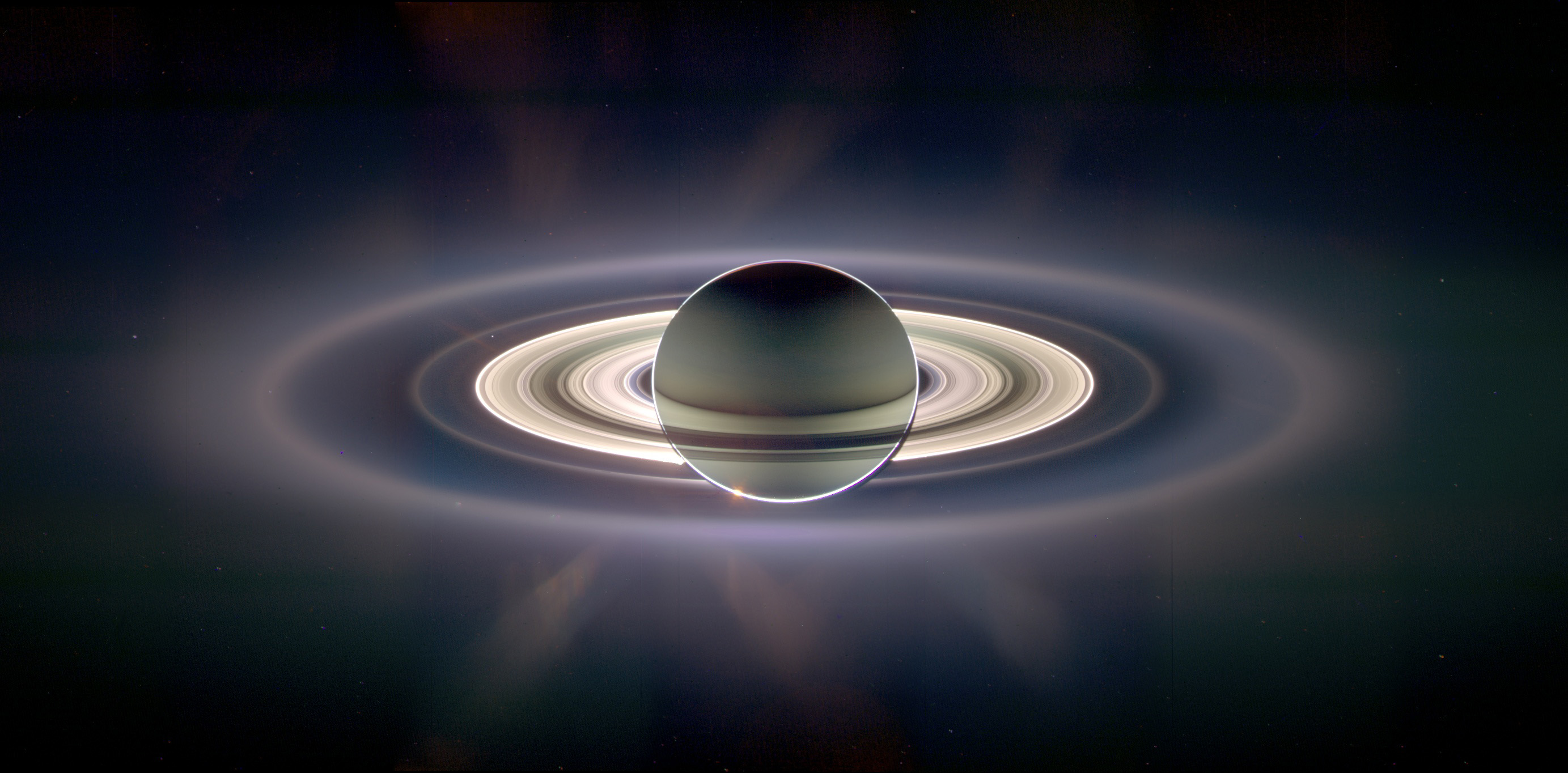
Saturn In Shadow


In the shadow of Saturn, unexpected wonders appear. The robotic Cassini spacecraft now orbiting Saturn recently drifted in giant planet's shadow for about 12 hours and looked back toward the eclipsed Sun. Cassini saw a view unlike any other. First, the night side of Saturn is seen to be partly lit by light reflected from its own majestic ring system. Next, the rings themselves appear dark when silhouetted against Saturn, but quite bright when viewed away from Saturn and slightly scattering sunlight, in the above exaggerated color image. Saturn's rings light up so much that new rings were discovered, although they are hard to see in the above image. Visible in spectacular detail, however, is Saturn's E ring, the ring created by the newly discovered ice-fountains of the moon Enceladus, and the outermost ring visible above. Far in the distance, visible on the image left just above the bright main rings, is the almost ignorable pale blue dot of Earth.


*from the A.P.O.D. Click image above to enlarge.