Showing posts with label Galaxies. Show all posts

Mar 31, 2010

What Do 10 Million Stars Look Like?

-FUPPETS- has the answer. From the good people at NASA's Astronomy Picture of The Day, here is a very crisp telescopic image of the globular star cluster Omega Centauri (named NGC 5139). Click the image below to enlarge.


Globular star clusters are large groups of stars that orbit around the edges of galaxies. This particular one orbits around our Milky Way galaxy, along with hundreds of others. Omega Centauri is the brightest and most densely packed of all the known star clusters. One strange thing about this star cluster is that it is far older than the other star clusters, with an approximate age of 12 billion years. It is also so densely packed in it's center that the stars there are less than .1 light year apart. That is ridiculously close by outer space standards. Just for comparison, the closest detected star to our Sun is Proxima Centauri, a red dwarf star approximately 4.2 light years away. If you happened to live on a world orbiting a star near Omega Centauri's center, it is likely you would never experience night, or what Earthlings consider night. The vast amount of nearby stars would ensure that even at "nighttime" the sky would never go dark. It is possible that even individual stars would not be discernible, just a flat field of light in the sky at all times. -FUPPETS- wonders what kind of mythology a species would develop without nighttime stars and celestial objects to ponder?

The image below is a tight close-up of the core of Omega Centauri. Click image for a larger version.


Most scientists think that Omega Centauri exists as the end result of an old galaxy colliding with the Milky Way, and scientists reported in 2008 that they have apparently detected a mid-sized black hole at it's center, which would also point to a galactic collision in the distant past as the cause of it's creation. It is hard to imagine that something so massive, with over ten million stars in it, is just a dwarf companion to our own galaxy. The Milky Way is also just a medium sized galaxy. There are galaxies out there with ten times the number of stars that our galaxy has. It is just a mind-boggling number and quite a humbling thing to ponder.

Dec 8, 2009

Farther in Time and Distance Than Humanity Has Ever Seen!

Recently, a shuttle mission was charged with doing the most intricate and exhausting repairs ever done while in "spacewalk" mode. These repairs replaced certain non-functioning components of the Hubble Space Telescope. One of the items replaced was the Wide Field Camera. This is the third Wide Field Camera installed on the Hubble.
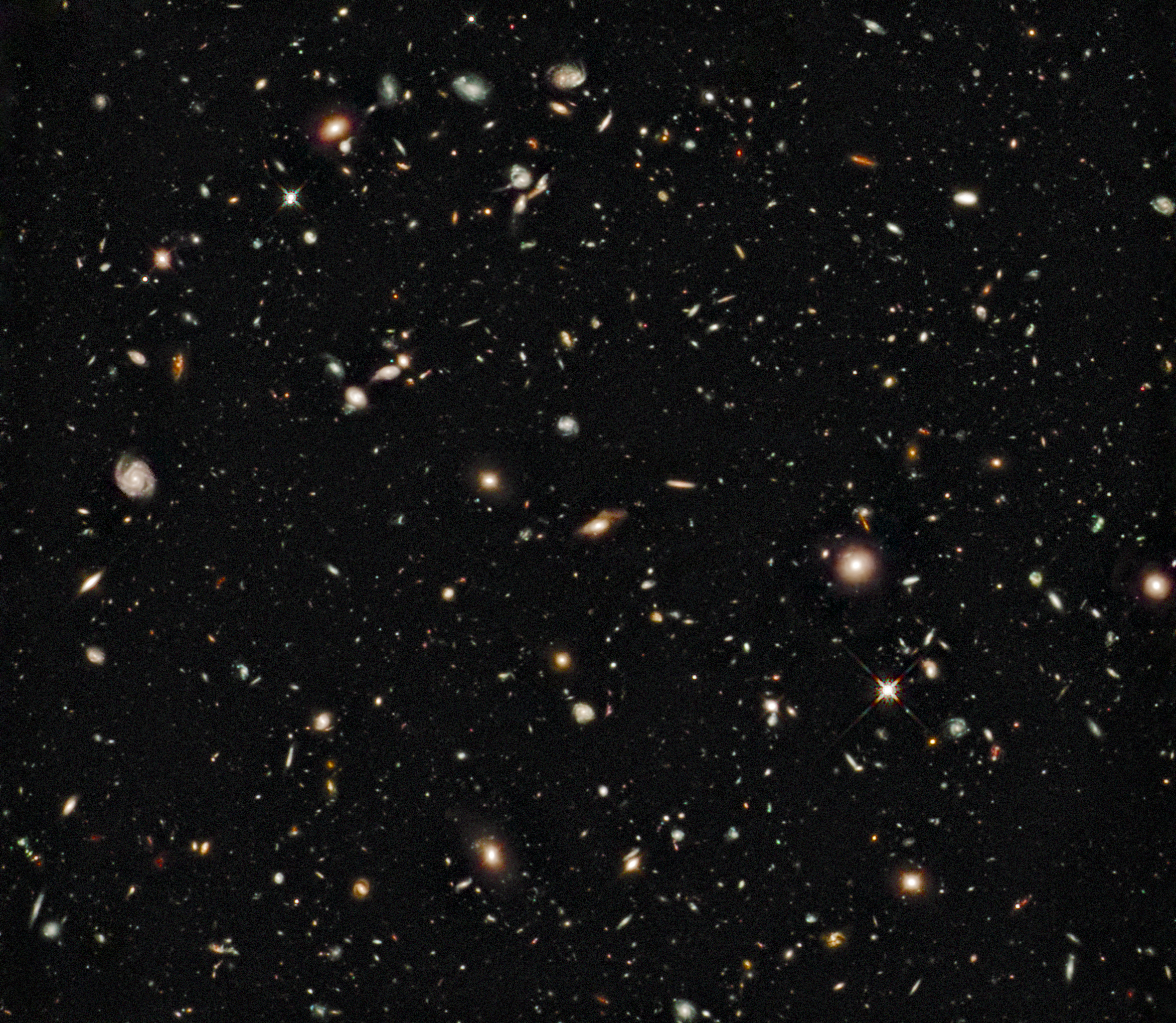
One of the most astounding accomplishments of the Hubble were the images called the Hubble Deep Field and the Ultra Deep Field images. These images were taken in 2004 by pointing the Hubble at what appeared to be a relatively empty region of deep space, zooming in, then finding the emptiest part of that deep image, and zooming in yet again. What was found blew the world's mind. More galaxies! Insanity! The Universe is so vast, so confoundingly enormous, that nothing in our human-scale set of reference points can help us visualize it properly. This is the Ultra Deep Field Image.


The first image above was taken this year, at a distance correlating with a time just 800-900 million years after the Big Bang. WOW! (Click on the top image to see the LARGE version. Galaxies, island universes all, abound.)
The photo was taken with the new WFC3/infrared camera on Hubble in late August 2009, during a total of four days of pointing for 173 000 seconds of total exposure time. Infrared light is invisible to the human eye and therefore does not have colours that can be perceived. The representation is "natural" in that shorter infrared wavelengths are represented as blue and the longer wavelengths as red. The faintest objects are about one billion times fainter than the dimmest visible objects seen with the naked eye. - ( Science Daily )


That means that over four days they created a 47 hour exposure! That is some super-faint light! The red-shift on these is immense. To imagine the awe that would be felt by someone such as Copernicus, or even Albert Einstein at these magnificent images. These images say far more about the wonder, skill, and glorious beauty of humanity than most people give them credit for.

-FUPPETS- says LONG LIVE SCIENCE!

Oct 30, 2009

3,000 Images Used to Make Panorama of the Milky Way!

Oh how -FUPPETS- loves astronomy. The world's oldest science is also it's most technologically advanced, and this provides -FUPPETS- with many occasions to love on the sights and wonders of outer space.
Dr. Axel Mellinger, of Central Michigan University, has used intricate mathematical models and over 3,000 images to create this PANORAMA OF THE MILKY WAY. ( <--- click to see the image ) What a beautiful thing. In today's world, most people live in cities. These cities are all illuminated artificially at night so most people in the world do not live day to day (or night to night) with the full spread of the Milky Way galaxy overhead. This used to be a constant companion to mankind, but ever since Thomas Edison crafted his filament and incandescent bulb, humans have brightened the night and dimmed the stars. The immense corrections needed to combine all these images are mind-boggling.
To combine these images, a simple cutting and pasting job would not suffice. Each photograph is a two-dimensional projection of the celestial sphere. As such, each one contains distortions, in much the same way that flat maps of the round Earth are distorted. In order for the images to fit together seamlessly, those distortions had to be accounted for. To do that, Mellinger used a mathematical model — and hundreds of hours in front of a computer.
Another problem he had to deal with was the differing background light in each photograph.
"Due to artificial light pollution, natural air glow, as well as sunlight scattered by dust in our solar system, it is virtually impossible to take a wide-field astronomical photograph that has a perfectly uniform background," Mellinger said.
To fix this, Mellinger used data from the Pioneer 10 and 11 space probes. The data allowed him to distinguish star light from unwanted background light. He could then edit out the varying background light in each photograph and fit them together so that they wouldn't look patchy. - ( Space.com )

AMAZING!

Since -FUPPETS- is talking about the Milky Way, here is a fitting video for you to enjoy.

THE CHURCH - Under The Milky Way

Sep 15, 2009

Interesting Finds Regarding Galactic Centers

-FUPPETS- loves galaxies. Oh yes. Galaxies, or "island universes," are what compose much of the matter in our visible Universe. In our very own Galaxy, dubbed the "Milky Way," there are upwards of a billion different stars, with thousands "born" out of the interstellar dust constantly, as seen below in this image of a stellar "nursery."


For our entire history, humans have gazed at the band of stars and dust that crosses our sky. Ever since Kepler's time, when we have known that we are in one galaxy which is a part of a bigger universe composed of billions of other galaxies, humans have tried to see the galactic center, to wonder what exactly resides there. The galactic center is obscured by dust clouds thousands of light years across. In our recent history it has been discovered that most galaxies have a very large black hole at the center. Ours appears to be no different.


The bright white spot towards the middle of the above image is a star cluster of several million stars located at the center of our galaxy, and it is believed this cluster surrounds a super-massive black hole. For the past few decades it was assumed that this is the case for most all galaxies. Scientists at The Swinburne University of Technology, however, have found otherwise.
The researchers at Swinburne concentrated on 50 regular galaxies to determine their composition. (Regular galaxies have well defined arms and spirals and are more prevalent. Irregular galaxies are more like fuzzy clouds.)
The researchers, Associate Professor Alister Graham and Dr Lee Spitler, found that 12 of these galaxies contained a double nucleus -- that is, they had both a super massive black hole and a dense star cluster containing up to ten million stars at their centre. - ( Science Daily )

Smaller galaxies were expected to contain a star cluster at their center, while larger galaxies were expected to have a super-massive black hole at the center. Finding 12 out of 50 to have TWO nuclei was a shock. In these galaxies, a super-massive black hole spins around a massive star cluster, each pulling on the other, and collectively providing the gravitation that holds the galaxies together. Amazing stuff. This opens up the possibility of very violent cosmological occurrences!
“When stars get too close to massive black holes, the gravitational attraction is such that they can be devoured,” Graham said. “When you’ve got up to a million stars within the immediate vicinity of a black hole, the chance of this occurring increases significantly.”
The predominance of double nucleus galaxies also means there are likely to be many more ‘hyper velocity stars’ in existence than astronomers had thought.
“This is when a star approaches a massive black hole and gets caught in a gravitational slingshot. When this happens stars can be ejected from galaxies at speeds in excess of 500 kilometres per second,” Graham said.
Another implication of the research – and according to the researchers one of the most exciting – is the increased likelihood of the phenomenon known as gravitational radiation.
“Such emission has been predicted by Einstein’s General Theory of Relativity, but has never been observed,” said Spitler. “It is theorised that when stars spiral quickly around a black hole the motion will create gravitational waves – causing ripples in the space-time continuum.”
The Laser Interferometer Space Antenna (LISA) – a suite of three satellites spaced five million kilometres apart and planned for launch in 2018 – is being designed to search for such ripples as they pass through our solar system.

Maybe our instruments will soon witness such an amazing thing. -FUPPETS- is psyched.

Apr 8, 2009

Galaxies Rule All

This beautiful image of NGC 7049, found in the constellation Indus, appears to be somewhere between a spiral and an elliptical galaxy. (Click image to enlarge)


The globular clusters in NGC 7049 are seen as the sprinkling of small faint points of light in the galaxy’s halo. The halo – the ghostly region of diffuse light surrounding the galaxy – is composed of myriads of individual stars and provides a luminous background to the remarkable swirling ring of dust lanes surrounding NGC 7049's core. Globular clusters are very dense and compact groupings of a few hundreds of thousands of stars bound together by gravity. - ( Science Daily )

What appears to be a smoke/fuzz/glow is the light of millions upon millions of individual stars. Amazing!
This image was taken by one of the many cameras on the Hubble Space Telescope, specifically, the Advanced Camera for Surveys.

Mar 23, 2009

Galaxies In Collision III

Dr. Halton C. Arp published a landmark work in 1966. In this treatise, titled The Atlas Of Peculiar Galaxies, Dr. Arp catalogued and named several hundred strange galaxies, or galaxy-like structures that did not fit the standard types more commonly found in the Universe (spiral, barred spirals, elliptical, amorphous etc.). An online copy of this catalogue, as well as links to a .pdf version, are available from the Caltech website. The preface to this catalogue is very informative. Images of the various galaxies can be found in this online version.
This is another website which compiles instructions so amateur astronomers can view these "Peculiar Galaxies." It also contains a link where you can purchase a beautiful book with color plates of many of Dr. Arp's galaxies.
One of these galaxies has been imaged in more clarity than ever before. It is called Arp 261, and is pictured below.

The image of Arp 261 shows what appears to be a very late-stage of galactic collision, as well as various other interesting objects. Not only are there dozens of galaxies in the field of view, each being far, far beyond Arp 261, as seen from earth, but there are two asteroids from within our own Solar System which happened to travel through the picture frame as this image was being exposed. They are labeled below, and appear as small streaks of red/green/blue. The reason for this color is that three different color filters were used in creating this exposure, and each one "colored" the small trail left by the two asteroids. A seemingly bright star is visible in the lower left-hand corner of the image. This star is contained within our own Milky Way. A very bright supernova is marked in the image below. It went supernova in 1995 and has maintained a very strong luminescence for the past decade! Scientists are curious as to why it is so bright, since supernovas normally flare up and dim down quite rapidly. They suspect that the brightness comes from the ejected star material colliding with very dense interstellar dust clouds, energizing them and causing them to give off continued bright light. Everything else seen in this image is very, very far away.

Mar 17, 2009

Galaxies In Collision II

Using NASA's Spitzer Space Telescope, scientists have captured an image of two galaxies in the late stages of a galactic collision. The two massive galactic cores are edging ever closer, nearly colliding. These galactic cores are composed of super-massive black holes and millions upon millions of stars. Here is the image from Spitzer.


This is treated as a single galaxy, NGC 6240, but what is now evident is that NGC 6240 contains two massive "cores" which are, in galactic terms, in imminent threat of collision.

The galactic cores are in a single, tangled galaxy called NGC 6240, located 400-million light years away in the constellation Ophiuchus. Millions of years ago, each core was the dense center of its own galaxy before the two galaxies collided and ripped each other apart. Now, these cores are approaching each other at tremendous speeds and preparing for the final cataclysmic collision. They will crash into each other in a few million years, a relatively short period on a galactic timescale. - ( Spitzer Press Release )
There have been many images of galaxies moving closer together, and even some that look like they are starting to collide, but this is the only galaxy in our near Universal neighborhood that shows such a late-stage development.

Streams of millions of stars are being ripped off the galaxy, forming wispy "tidal tails" that lead off NGC 6240 in several directions. But things are about to get even more violent as the main event approaches and the two galactic cores meld into one.
In the center of NGC 6240, the two black holes in the cores will whip up a frenzy of radiation as they careen towards one another head-on, likely transforming the galaxy into a monster known as an ultra-luminous infrared galaxy, thousands of times as bright in infrared as our Milky Way.

Beautiful stuff. These type of massively scaled events take place all the time in our Multi-verse, and we are very lucky to have a tool capable of detecting such magnificence. While it does dwarf the human scale of things, it is also quite a grandiose and awe-inspiring thought to imagine that us lowly hairless apes can construct tools that allow us to explore the Universe, and not only that, but we can construct theoretical models which describe this Universe in precision of one part in a billion. Long live the HUMAN BRAIN.

Mar 4, 2009

Galaxies In Collision


It is sometimes hard to grasp just how incredibly large a galaxy is, much less the entire Universe. An average galaxy can contain over a billion individual stars, and most galaxies are constantly creating new stars which coalesce from the massive clouds of interstellar dust. As far as current estimates go, there are likely over a trillion galaxies in our observable universe. This is an amazing amount, and the human brain does not have the ability to fully comprehend such large numbers.
Galaxies have life cycles too. Even though the distances between stars is vast, the distances between individual galaxies are exponentially larger. It is rare to see galactic collisions, but the Hubble Space Telescope has found many. Our own Milky Way galaxy is rushing towards the Virgo Galactic cluster, and in a billion years or so will be actively "colliding" with the cluster. This is what is happening in the image above. (Click image above to enlarge.)
The Hubble Space Telescope has captured the above image of three different galaxies in the middle of a collision. Even though scientists term this a collision, it is very rare indeed that any two individual stars would actually crash into each other, the distances between them being so vast. It is like having two people blow smoke at each other. The smoke particles would intermingle and affect each other but would likely never actually touch. In galactic collisions the same is true. However, the gravitational pull of all the stars and the galaxies collective gravitational power do affect each other. For example,
The three pictured galaxies — NGC 7173 (middle left), NCG 7174 (middle right) and NGC 7176 (lower right) — are part of the Hickson Compact Group 90, named after astronomer Paul Hickson, who first catalogued these small clusters of galaxies in the 1980s. NGC 7173 and NGC 7176 appear to be smooth, normal elliptical galaxies without much gas and dust.
In stark contrast, NGC 7174 is a mangled spiral galaxy, barely clinging to independent existence as it is ripped apart by its close neighbours. The strong tidal interaction surging through the galaxies has dragged a significant number of stars away from their home galaxies. These stars are now spread out, forming a tenuous luminous component in the galaxy group. - ( Science Daily )

The gravity of the large elliptical galaxies is effectively ripping apart the barred spiral galaxy. Scientists expect this process, which will take hundreds of thousands, if not millions of years, to create a massive galaxy, tens of times bigger than our own Milky Way. If only we could create a time-lapse camera that could capture the entire process. It would look something like this.

Feb 6, 2009

NGC 4921, In The Coma Galaxy Cluster


Everywhere one looks in space, in any direction, billions of galaxies each with billions upon billions of stars surround our Milky Way. Many of these massive formations have attracted each other through their gravitational pull, and reside in areas called Galaxy Clusters. The Coma Galaxy Cluster, about 320 million light years from earth, contains over 100 galaxies.

Galaxies come in several varieties:

Spiral Galaxies like the one below have distinguishable "arms" which create the spiral effect, as the center of the galaxy spins faster than the outer regions.


Barred Spiral Galaxies have one large "bar" which begins forming a spiral at it's two ends. This one is rotating clock-wise as seen from our planet Earth.


Elliptical Galaxies have a nearly uniform shape, and the brightness from all it's stars seems to come from the entire galaxy, which is not divided into arms or spirals.


The galaxy at the top of this post is in the Coma Cluster and is a very rare type of spiral galaxy, and very beautiful. Click here for more information about it.
"It is an example of an "anaemic spiral" where the normal vigorous star formation that creates a spiral galaxy’s familiar bright arms is much less intense. As a result there is just a delicate swirl of dust in a ring around the galaxy, accompanied by some bright young blue stars that are clearly separated out by Hubble’s sharp vision. Much of the pale spiral structure in the outer parts of the galaxy is unusually smooth and gives the whole galaxy the ghostly look of a vast translucent jellyfish." - ( Science Daily )
Take a look at the top image. Notice the dozens upon dozens of other galaxies far in the background! They are everywhere! We are magnificently inconsequential.

Oct 21, 2008

EINSTEIN RINGS - Man, He Was a Bad Motherfucker


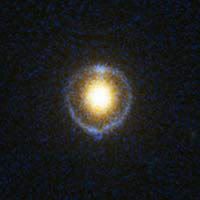
The image above is an example of an Einstein Ring. Physicist and Uber-human Albert Einstein sent a mindfuck wave through the whole of Humanity's collective consciousness that has yet to reach it's peak and crash. One of the many postulates that can be deduced from Einstein's Theory of General Relativity is that, since light itself can and is bent by gravity, very large gravity sources can act as a magnifying "lens" in outer space, showing us the slightly distorted light emanating from behind the large gravity sources. These are called gravitational lenses. They can be created by other galaxies, black holes, and even regions of dark matter in deep space.

The above image shows what scientists call an Einstein Ring. Imagine two galaxies, on every very far away and another halfway to Earth but situated almost directly in the middle of our sightline to the other galaxy. That is what you see above. The faint blue "ring" around the glowing irregular/elliptical galaxy is actually the light from a galaxy itself, having been bent and distorted by the massive gravitational pull of the galaxy in front (the yellow one).


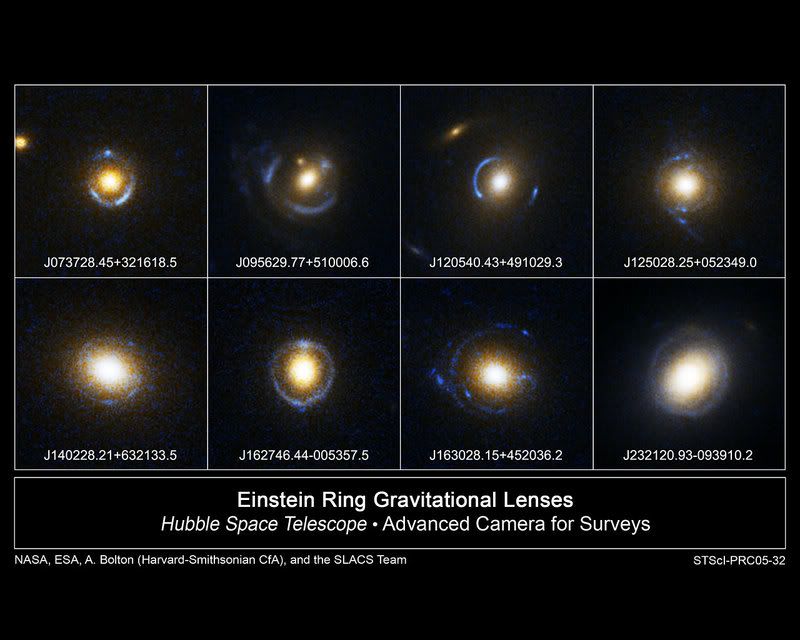
The image above (click to enlarge) collects 8 different Einstein rings. Finding these visual anomalies is extremely difficult and time consuming. For astronomers on Earth though, these lenses can shed new light on deeply mysterious questions about our macroverse and it's life-cycle. They also allow the study of galaxies and inter-stellar matter that would otherwise be invisible to us.


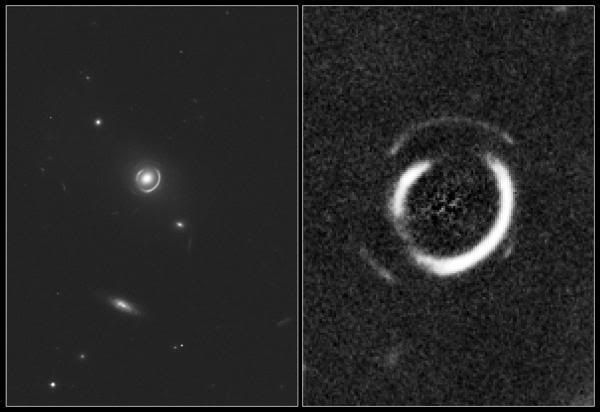
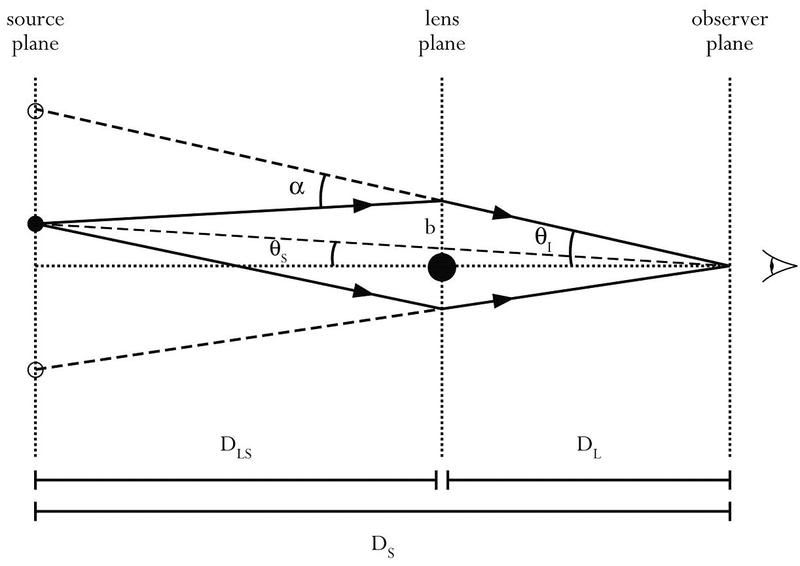
This image is one that completely surprised and excited scientists. What you see above is a DOUBLE Einstein Ring! This is the first one yet discovered. In the case of this image, there are two galaxies situated like beads on a necklace way beyond the gravity source for this lens, an elliptical galaxy. Fucking amazing. Below is a diagram showing the geometry necessary for these Einstein Rings to be visible here on Earth. These are not actual physical rings out in space, remember. They are just optical distortions. (click to enlarge)


Albert Einstein was always a huge fan and supporter of -FUPPETS- and -FUPPETS- would not have it any other way.