Showing posts with label Nature. Show all posts

Jul 8, 2010

CORPSE FLOWER To Bloom In Houston Soon

-FUPPETS- has been interested in the Titan Arum, or Amorphophallus Titanum, since first reading about this strange flower years and years ago. It is one of two flowers that are both called "corpse flower" due to the highly intense rotten flesh smell that is released by the flowering plant when it is ready to pollinate. It is also one of the rarest plants in the world, originally from Sumatra.
It's Latin name means "misshapen phallus", or "phallus without form," and it is easy to see why. Here is an image of the Museum's flower as it currently appears.


Here is an image of what it will look like once it flowers.


The Houston Museum of Natural Science (HMNS) has been growing one of these plants from a small root bulb for 6 years in the Cockrell Butterfly Center, which is part of the HMNS.

See the Corpse Flower at HMNS! [Amorphophallus titanum] from HMNS on Vimeo.


There have been only 28 blooms of the Titan Arum in the United States. The individual plants may only bloom once in their long life. The HMNS is expecting their flower to bloom this weekend or sometime next week. The lime green bud has been growing at a rate of about 4 inches PER DAY!
"As it's common name warns, the corpse flower is a smelly thing, with the whithering stench of rotting flesh. As the spathe begins to unfurl, the spadix becomes a gas chamber, heating it's natural oil and emitting noxious fumes for 8 to 12 hours to attract pollinating carrion beetles." - ( Kathy Huber - Houston Chronicle )


So go to the Houston Museum of Natural Science this weekend and take a look at, and maybe a whiff of, one of nature's wonders. You may never get another chance.

Aug 19, 2008

Bacteria Are Beautiful


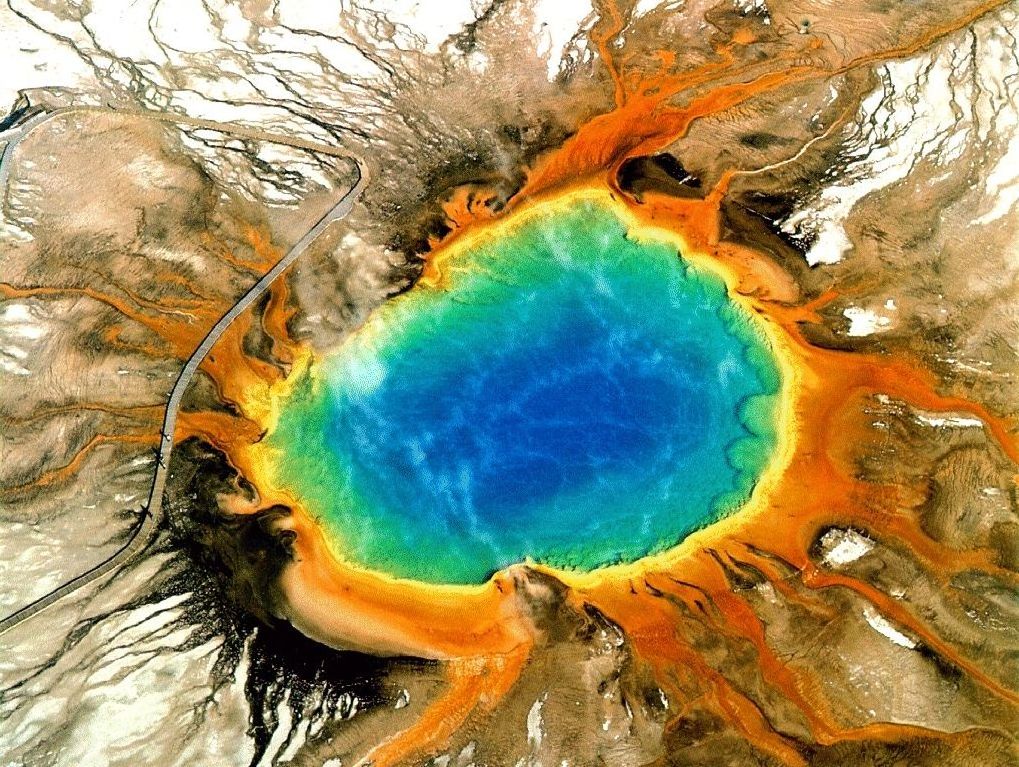
These images are from the Grand Prismatic Spring in Yellowstone Park. Yellowstone is well-known for it's amazing geological formations, including hot springs, bubbling mud, bacterial pools, geysers, etc.
The following quote is from the NASA website that has these satellite images of the Grand Prismatic Spring.


It is 90 meters (300 feet) across and 50 meters (160 feet) deep. In the center
of the pool the water is 87° C (188° F)—too hot to support life. In the cooler
water along the edges of the pool, however, colonies of thermophilic
(heat-loving) cyano-bacteria and algae thrive. Yellow, orange, and red pigments
are produced by the bacteria as a natural sunscreen. As a result, the pool
displays a spectrum of colors from the bright blue of the center to the orange,
red, and brown algal mats along the edges.