Showing posts with label Fossils. Show all posts

Apr 6, 2010

-FUPPETS- Loves Amber


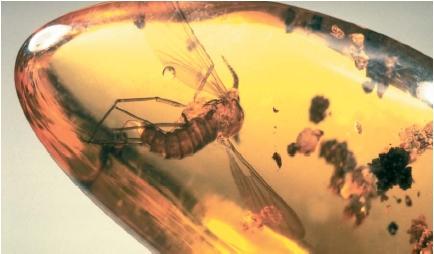
The above image is of a 95 MILLION year old piece of fossilized amber taken from an Ethiopian deposit which is the first of it's kind found in the continent of Africa. That would place the animals, pollens, and fungi found in this amber in the Cretaceous Period, a time in our planet Earth's history that saw the rise of flowering plants, and all the other creatures that flowering plants helped to survive.

"Until now, we had discovered virtually no Cretaceous amber sites from the southern hemisphere's Gondwanan supercontinent," says author Paul Nascimbene of the Division of Invertebrate Zoology at the American Museum of Natural History. "Significant Cretaceous amber deposits had been found primarily in North America and Eurasia."
"The first angiosperms, or flowering plants, appeared and diversified in the Cretaceous," says first author Alexander Schmidt of the University of Göttingen in Germany. "Their rise to dominance drastically changed terrestrial ecosystems, and the Ethiopian amber deposit sheds light on this time of change." - ( Science Daily )


No one knows yet what tree produced the saps that made the deposit, but it is definitely sap from what is called an angiosperm, a designation stating that means it is from a flowering plant. Flowering plants have sex. The flowers allow for pollination between sometimes far-separated plants, enabling the mixing of genetic material. The chemical designation for this specific amber deposit is Class 1c, the only such one yet discovered. Other Cretaceous amber deposits that have been discovered are definitively from gymnosperms, or non-flowering plants.


There is always so much to intrigue scientists from various disciplines when amber deposits of this type are discovered. Botanists want to see the pollen, or plant matter. Biologists of various types want to study the trapped animals inside. It is a very inclusive situation, and allows for vast discovery, such as how. . .
. . .team members discovered 30 arthropods that had been trapped in the amber from thirteen families of insects and spiders. These fossils represent some of the earliest African fossil records for a variety of arthropods, including wasps, barklice, moths, beetles, a primitive ant, a rare insect called a zorapteran and a sheet-web weaving spider. Parasitic fungi that lived on the resin-bearing trees were also found, as well as filaments of bacteria and the remains of flowering plants and ferns.

-FUPPETS- loves science. Every answered question leads to dozens of new questions. Our inexhaustible curiosity is matched only by the inexhaustible information to be gathered by us from the Universe.

Aug 27, 2009

Fossils Continue to Kick Ass!


The image above is an actual fossilized feather, around 40 million years old. What scientists have found in this fossil is the first evidence for iridescence, in the form of a color-producing nano-structure, in ancient feathers. There are various ways for color to appear on organic material. Some colors are due to pigment, and some are due to light refraction. The latter is what was found in the above fossil.

The simplest iridescent feather colors are produced by light scattering off the feather's surface and a smooth surface of melanin pigment granules within the feather protein. Examining feather fossils from the Messel Shale in Germany with an electron microscope, scientists have documented this smooth layer of melanin structures, called melanosomes.
"These feathers produced a black background with a metallic greenish, bluish or coppery color at certain angles—much like the colors we see in starlings and grackles today," said Richard Prum, chair of the Department of Ecology & Evolutionary Biology at Yale - ( Science Daily )


Soft-tissue fossils are among the most rare. For the past few decades scientists have noticed these tiny tubular presences on feather fossils, and until recently thought that these things were bacteria that had eaten at the feather before becoming fossilized.
Since light refracts at specific angles, creating specific "colors," they can accurately determine the color of some extinct species. Scientists hope to use this information to accurately determine the color of feathered dinosaurs.

Check out the iridescence on this bird. The bird's got some attitude too!


Sep 4, 2008

AMBER - NATURE'S TIME MACHINE


There are many different ways for animals and plants from our Earth's past to become fossilized, which allow us to study and analyze these long-lost specimens. For a long time, humanity did not know what to make of the fossils that would turn up, assigning legend to these remains. Large, seemingly incomprehensible bones coming out of the Earth no doubt spurred the human imagination to create tales and myths of monsters, dragons, and giants in Earth's past.
While most fossils discovered by humans are found in ancient sedimentary rocks, which over millenia turned the organic remains into stone, a slow process which is called ossification, there are a few types of fossils in which the organic remains have not been converted to stone. Natural asphalt (imagine the La Brea Tar Pits for example), peat (like the thousands of years old "mummies" found in the Scottish peat bogs), and -FUPPETS- personal favorite, AMBER, all preserve ancient specimens without actually destroying the organic remains.


AMBER is the fossilized remaining part of tree resin. When resin/sap first
flows from the tree, it is very thick and sticky, so as it runs down the trunk,
it may trap insects, spiders, and occasionally larger animals such as lizards.
These organisms can be preserved for millions of years with details of their
soft tissue, such as muscles and hair-like bristles, still intact.

Amber is a non-crystalline solid, mostly translucent, although opaque amber has been found, and it is a highly statically charged substance. Ancient alchemists would use amber to extract electrons from, though they did not know why their rubbing of amber caused a spark to occur. This property gave it supposed mystical qualities, just like lodestone's magnetism was seen as mystical in nature for thousands of years.
Possibly the single greatest quality of Amber is that it preserves near perfectly the soft tissue remains of ancient organisms, while allowing someone to view the fossil without destroying the piece of amber it is encased in, something no other fossil can provide.

This very rare specimen contains a tiny extinct frog inside.


This piece of Amber shows a tens of millions of years old mosquito inside.


This image shows a million year old cockroach surrounded by other critters.


This bad motherfucker has a praying mantis inside!


It is just mind blowing to -FUPPETS- how beautiful these fossils can be. The variety is staggering. For example, it is not just animals that get stuck in the sap, but plants as well. The following image is of an encased bee and an orchid flower. (Click on any of the images to enlarge)


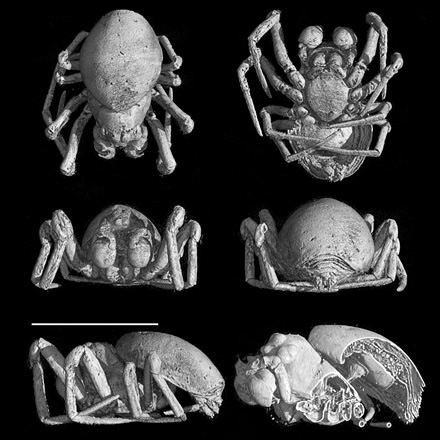
Some amber however, is very opaque, and to see what is inside involves destroying the specimen. No longer! French scientists have developed a new technique to see inside these amber specimens. They use X-Ray's to build up an image of the interior of the amber, and can the see in very high detail, the animal/plant within. Here is an example of a spider fossil, which can now be seen in full 3-D.


Aug 28, 2008

FOSSILS FUCKING RULE!

Fossilized remains of ancient creatures are some of the most beautiful things that the natural processes of geology can create. Fossils are the only window we humans have to a time, nearly inconceivably long ago, when creatures that first populated the Earth were alive and kicking. For centuries humans have pondered what these weird bone-shaped stones were, until it was realized that they were truly ancient remains. There are now many recognized processes by which plant and animal matter can be fossilized. The more we know about the process the easier it is to locate the exposed places on Earth where fossils are likely to be found. But check this shit out.

A turtle that toddled alongside the dinosaurs died just days before laying a clutch of eggs. Now, about 75 million years later, paleontologists are announcing their find of the fossilized mother-to-be and the eggs tucked inside her body. - Jeanna Bryner - LiveScience.com

There have been thousands upon thousands of fossils found, of nearly every possible type of creature, including a shit-ton that are no longer existing today. The first time that fossilised dinosaur eggs were discovered, people did not want to believe such fragile things could survive over 100 million years. This pregnant river turtle, a species long extinct, is the first obviously pregnant fossilized animal ever discovered! It is indeed amazing. The chances against an animal dying in just the right plafce to prevent decay and promote fossilization are nearly infinitessimal, but to find a pregnant animal? Truly rare indeed. Pictures are not yet available.