Showing posts with label Mars. Show all posts

Nov 12, 2009

NASA Unveils Plan to Free the Mars Rover SPIRIT!

It has been months in the making, and countless theories and possibilities brainstormed, but NASA has announced that it has a plan in place to begin what will hopefully accomplish the extraction of the Mars Rover SPIRIT from the "quicksand" trap it has been embedded in.


The "soil" is so fine it more closely resembles talcum powder than what we could call sand or dirt.

Click HERE to see a full circle panorama of Spirit's current location.

Click HERE to see a large image detailing the path of the Mars Rover SPIRIT since arriving at the plateau designated "Home Plate." The yellow line marks the path taken, and you can see the location of SPIRIT's current predicament, labelled "Troy."

They will begin to run the extraction program on Monday. Scientists expect it to be a painstakingly slow process, but little by little, they hope to once again have SPIRIT roaming free on Mars. Even if the worst occurs, and they are not able to extract SPIRIT from it's sandy trap, the area where it is located is highly rich in geological oddities, and much good science could still be done. -FUPPETS- hopes it does not come to that!

May 28, 2009

Humanity's Surrogate On Mars Nears It's End *UPDATED*

In January of the year 2004, humans from the country called the United States Of America sent towards Mars two remotely operated vehicles named Spirit and Opportunity whose mission it was to explore the Martian geology with some of the most advanced and innovative equipment they could create.


They landed safely and have been crawling along the surface of Mars for these past five years, surviving broken wheels, dust storms, Martian winters of minimal sunlight to power themselves, ridiculous cold and unbearable heat.

Both rovers were originally expected to fulfill a 90 Martian day mission. They have far exceeded humanity's expectations and hopes for them.
At the start of this month, Spirit became stuck in sand/dust that was described by NASA scientists as akin to the finest of talcum powder.
In the vastness of our solar system and of space it is the small things that can kill you. The other rover, Opportunity, is way too far away on the other side of the planet to come and help in any way. Spirit already had been driving backwards for the better part of three years due to a broken right front wheel it has been dragging along behind it.


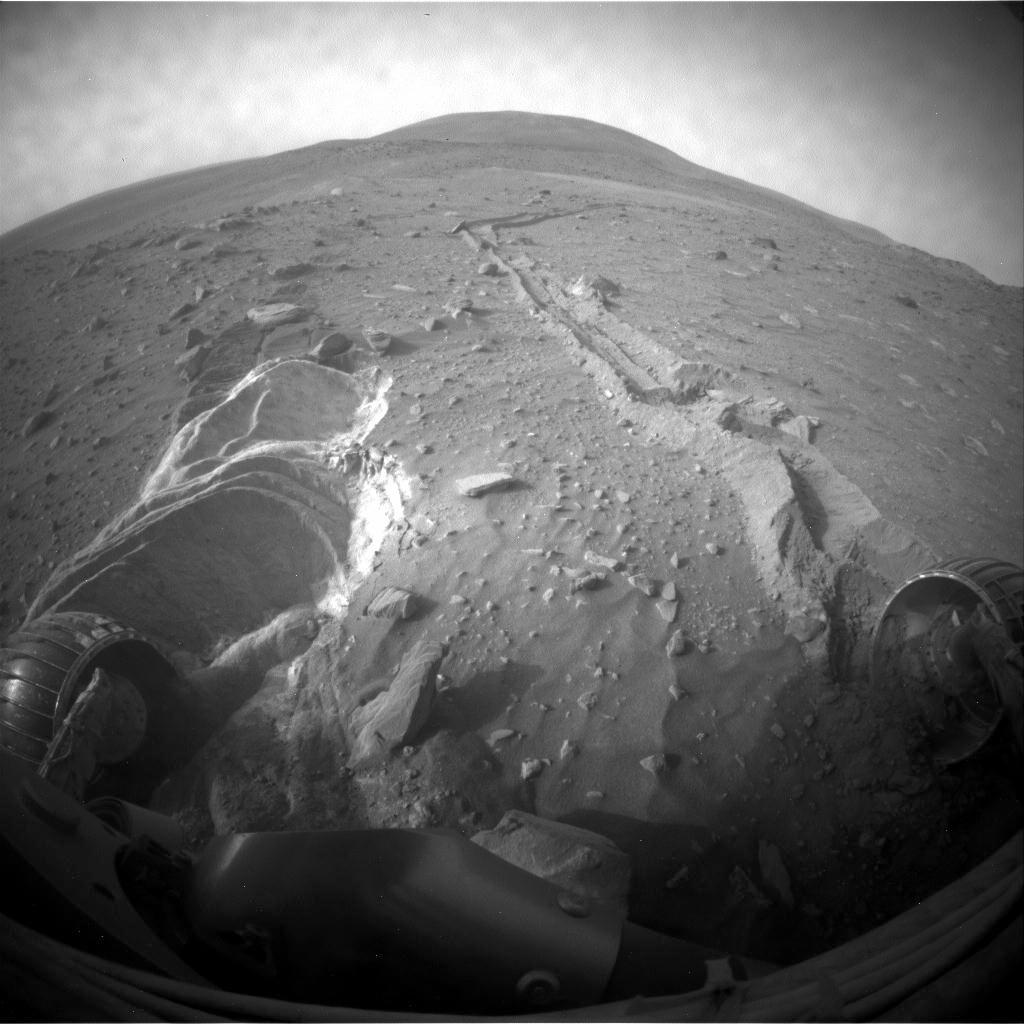
The Rover's broken wheel ironically allowed it to make a great discovery when, as shown in the image above, the wheel scraped off the Martian topsoil and exposed a white substance that turned out to be ice. This was a great discovery.
The Rovers have been stuck in dunes before, but this one appears to be too much to overcome. Scientists are busy planning different strategies to try and free Spirit. -FUPPETS- will keep you updated as events occur.

*Below is an image of the MARS Rover Spirit. taken by itself, showing the current situation and the soft terrain it is stuck in. Click the image for a more detailed, and larger version.

Jan 5, 2009

-FUPPETS- Celebrates 5 year Anniversary of the Mars Exploration Rover Mission!


Our history of efforts with Martian spaceships is fraught with failure. Many of our spacecraft either are lost in flight, or have crashed into the Red Planet. Many of the missions that have survived the perils of intra-solar-system travel have been short lived. That is not the case any longer.
In what may very well be the single most successful and fruitful unmanned mission in the history of humanity, the two Mars Exploration Rovers, Spirit and Opportunity, are still kicking and rolling around the surface of mars, after FIVE YEARS! They have survived the harsh Martian winter 5 times, due to excellent engineering, painstaking construction, and inventive operations by the crews in charge of actually driving and programming the Rovers.
This is an amazing achievement, and one which is not being given enough praise in the regular news media, other than as a curiosity. -FUPPETS- is fucking amped up about this shit, you can be sure.
There have been mechanical issues, and one of the rovers is operating with just 4 of it's original 6 wheels, but the biggest issue the rovers have faced is one of dust. The Martian dust is very fine and covers the solar energy panels with a fine layer which obstructs the solar energy the rovers are dependent on. Below is an image of Spirit on it's one-year anniversary. You can see the layer of dust on it's solar panels.


On the Moon, this would be fatal, but on Mars, which does have a tenuous atmosphere, occasional wind storms actually serve to clean off this dust! This was a purely lucky occurrence which the NASA scientists were overjoyed at experiencing. Without these random dust storms the rovers would have died a long time ago. At one point, Spirit was operating at less than 60% of the energy it normally needed, when, in a completely unexpected surprise, the power capabilities jumped to over 93%! Once the scientists had gotten over their joy they realized that a "dust devil" had miraculously swept across the Spirit Rover, and cleaned off much of the Martian dirt from the solar panels. Incredible. This has happened repeatedly for both Rovers and is the main reason they are still going today. Below is an image of Spirit, 6 months after the above image, with it's solar panels clean.


Here is a Martian "dust devil" photographed by Spirit.


Human ingenuity and skill and intelligence fucking rules all. Here's hoping the Mars Rovers continue in their mission. When you look to the sky at night, take the time to ponder about these extensions of our humanity that are out in the bitter cold of a foreign planet, doing the dirty work that humans need done so as to allow our species to spread and prosper throughout the Solar System, as we need to do, for we are explorers first and foremost.

Dec 29, 2008

-FUPPETS- Loves The Top 5 Astronomy Discoveries Of 2008

Hell yeah. There is nothing better than astronomical discovery, for it just keeps highlighting and emphasizing the exceedingly unimportant and superfluous nature of human existence. YOUR "PROBLEMS" DON'T MATTER! As the year 2008, which was not two-thousand-GREAT as previously predicted, draws to a close, the good folks at Space.com have compiled a list of the top 5 most astounding astronomical discoveries of the past year.

5. Mercury's Mysteries
More than half of our solar system's smallest planet (Pluto once took this honor), Mercury, had remained a mystery until this year. On Jan. 14, NASA's MESSENGER probe made its first flyby of Mercury, beginning a mission to image the entire planet.
From the get-go, the probe sent back intriguing images, including clear evidence for volcanoes. Images of the Caloris basin showed hints of lava flows and the presence of a shield volcano larger than the state of Delaware, with gently sloping sides.
And Mercury is indeed shrinking as its iron-rich core slowly cools. Scientists had speculated this much from images taken during the Mariner 10 mission in 1974. But MESSENGER images showed more faults than did Mariner 10, suggesting the strain from the planet's contraction was at least one-third greater than originally thought.
The thousands of images and other data collected by MESSENGER could also shed light on other Mercury mysteries, including the planet's relatively giant core, which makes up about two-thirds of the planet's mass.


4. Black Hole Antics
Black holes are so dense that nothing, not even light, can escape their gravitational grips. Though invisible, astronomers have inferred the presence of the dark behemoths from their effects on nearby objects. And this year, it seems, all the crazies came out of their cosmic closets.
Take the fastest spinning black hole, found to whirl around at speeds approaching the speed of light.
And when it comes to obesity,
one black hole could've gobbled up 18 billion suns. This giant would dwarf the smallest black hole found this year, weighing in at about 3.8 times the mass of our sun and spanning just 15 miles (24 km) in diameter.
Researchers also found this year that some supermassive black holes, which reside at the centers of many or all galaxies, spew out giant bubbles from the tips of their jets. (As material falls into the gravitational clutches of a black hole, the energy can be spit out as jets of radiation and high-speed particles.) The bubbles ultimately pop, spilling their gaseous guts. Turns out, the hot gas keeps the black hole and its galaxy from ballooning to mega sizes.
Black holes can also take the form of "masked fugitive." Computer simulations revealed that when two black holes merge, the energy produced can kick the newly merged black hole clear out of its galaxy.
Also, for the first time this year, scientists detected such
a rogue black hole racing along at 5,900,000 mph (2,650 kilometers per second).

3. Dark Energy
Scientists were hot on the trail this year of a mysterious "force" called dark energy that has been expanding the universe at an increasing pace and was only discovered about 10 years ago.
Though, admittedly, scientists say they are more than a few years away from solving the puzzler of what dark energy is, a new method this year confirmed its existence, suggesting the force is
stifling the growth of galaxies in the universe. Basically, in an expanding universe dominated by dark energy, galaxies fly away from one another rather than mingle and merge.
These results also suggest dark energy takes the form of what Einstein called the cosmological constant — a term in Einstein's theory of general relativity that represents the possibility of empty space having a density and pressure associated with it.


2. Martian Life?
The red planet has gotten celebrity treatment this past year, with the touchdown of NASA's Phoenix Mars Lander in May, the continuing presence of the Mars Exploration Rover twins (Spirit and Opportunity) and NASA's Mars Reconnaissance Orbiter (which has imaged nearly 40 percent of the planet).
A major goal of such missions has been to find signs of past or present liquid water, the main ingredient for life. That's why Phoenix snagged a star-studded headline when the lander
collected water ice near Mars' north pole this year.
Earlier in the year, Spirit found deposits of silica in Gusev Crater, suggesting, scientists said, that hot water once flowed through the Martian soil in hydrothermal vents. As on Earth, these hydrothermal vents may have once harbored life. The discovered silica could preserve fossils of such ancient life if it did indeed exist there.
And just in from MRO — evidence of carbonates on the Martian surface. Since carbonates can't survive in acidic, harsh conditions, the mineral finding suggests any microbes crawling around when Mars was wet could've enjoyed a cushy existence.


1. Alien Worlds
With the extrasolar planet tally now well above 300, astronomers seem to be on track for spotting another Earth (the astronomical jackpot) before long. Along the way this year, a jaw-dropping announcement came in November when two teams of astronomers reported they had snapped direct images of exoplanets.
Geoffrey Marcy of the University of California, Berkeley, calls the images "the most spectacular thing in 2008."
"In my own professional opinion this is by far the most definitive picture of a planet ever taken," Marcy said during a telephone interview, referring to the direct image by the Hubble Space Telescope of the planet called Fomalhaut b.
The gold rush of exoplanet discoveries this year boils down to new techniques and observatories as well as energetic astronomers involved, Marcy said.
Some other highlights include: the least-massive planet, weighing in at just three times the mass of Earth; the hottest planet, with temperatures reaching about 4,000 degrees Fahrenheit (2,200 degrees Celsius); and three so-called super-Earths orbiting a star.
Astronomers like Marcy predict the upcoming year will bring us even closer to detecting Earth's twin. For instance, NASA's Kepler mission is scheduled to launch in March with the goal of finding rocky planets about the size of Earth that orbit within the habitable zone of their host stars where liquid water and life might exist. Stay tuned.

Nov 24, 2008

NAME NASA'S NEW MARS EXPLORER!

Mars has been in the news a lot lately, partly due to the unexpected and overwhelming success of the Mars Rovers, and of the Phoenix Mars Lander. If you know of anyone under 18 that is interested in outer space and space travel and such bad-ass fucking things, take them over to this NASA website, http://marsrovername.jpl.nasa.gov/, where they have instructions for kids to write in and suggest names for the new Mars Rover.

Here is an image of the new Rover, yet to be named, as they are placing it in the protective ring which will encapsulate it as it makes it's trip to the planet Mars. (Click image to enlarge)

Once it is inside, they will then take it all apart again, triple-check all the devices, connections, and wiring, and the proceed to put it all back together yet again in time for launch. This exhaustive process is the only way to ensure that every possibility has been checked out, and it allows for multiple redundancies, in case something were to fail. It is the only way to go when you have a project that takes 5-10 years to come to fruition only to fully operate out of the guiding eyes and hands of the people that put it all together. INSANE!

Oct 8, 2008

NASA's Phoenix Mars Lander is Nearing It's End

from Space.com


After more than four months on the arctic plains of the red planet, NASA's
Phoenix Mars Lander's days are finally numbered.As the sun begins to set for the
frigid Martian winter, the spacecraft will lose its energy supply, freeze and
eventually fall into a mechanical coma from which it will likely never wake
up.

After years and years of failed missions to Mars, and of catastrophic errors, it is sad to see one of the most successful robotic missions ever attempted by NASA come to a close. The Mars Landers have sent back invaluable information and images, and have far exceeded their original 3 month timetables. The Phoenix Mars Lander is in the northern "arctic" region of Mars and is rapidly losing power. It receives most of it's energy from solar cells and the long dark winter on Mars is about to begin.

Due to Mars' inclination, the northern and southern poles are either facing full time sunlight or facing away from the sun with constant darkness and bitter cold.
The Lander was provided with what scientists call a "Lazarus Mode," a re-boot program that may start the Lander and try to communicate with earth when, and if, the solar array manages to get new sunlight energy in a few months.

That would be fucking cool as shit if it were to successfully "hibernate" and then begin to send back data again after the Mars winter. -FUPPETS- wishes the Phoenix Mars Lander all the luck in the Solar System.